What Is Semi Hydroponics and Why It Suits Tropical Foliage Indoors
Short answer: is semi-hydroponics suitable for tropical foliage plants? Yes. A well-managed semi-hydro system can provide consistent moisture and root aeration through an inert substrate and shallow nutrient reservoir. Light, temperature, water level and hygiene still determine success.
Tropical foliage plants often struggle indoors because watering, light, temperature and root aeration fall out of balance. Colocasia can be especially awkward in British homes: it wants reliable moisture during active growth, but cool, saturated compost can still damage roots.
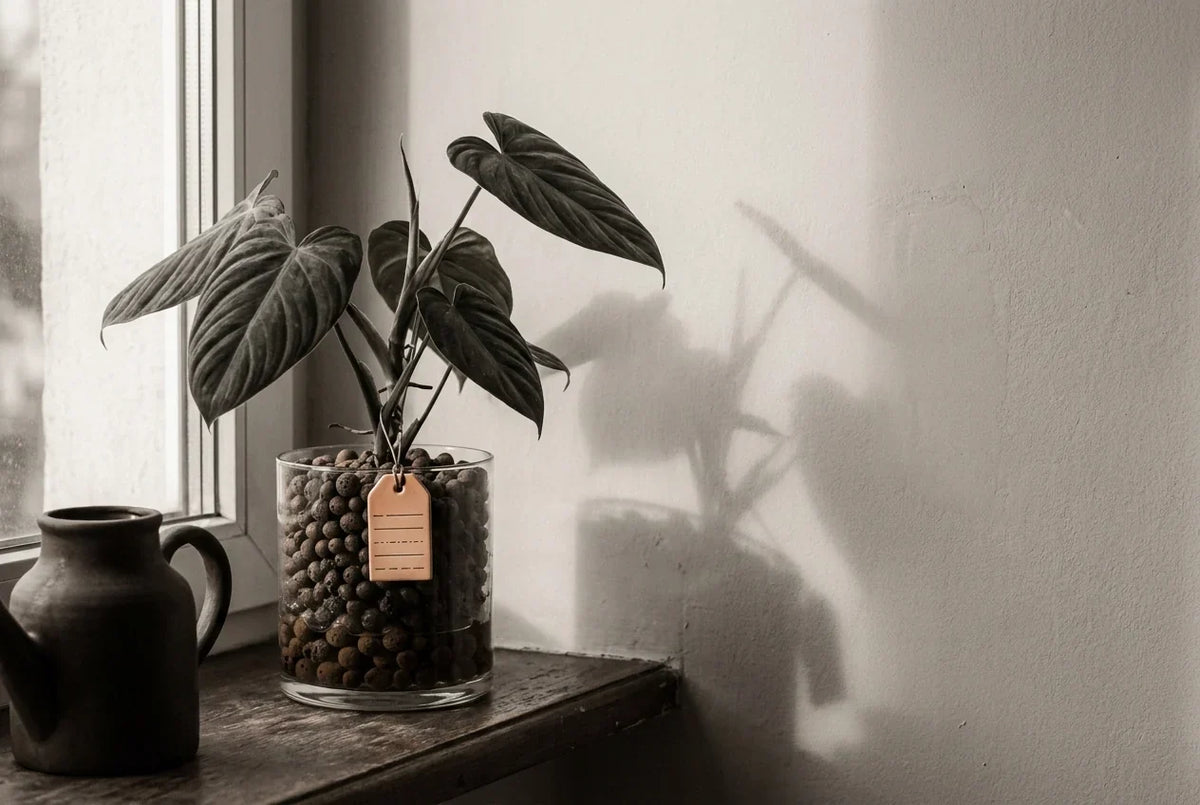
Semi-hydroponics means growing plants in a mineral-based, inorganic substrate paired with a passive water reservoir. Capillary action keeps part of the substrate moist and gives the grower a visible reserve of water. It can make watering more predictable, but reservoir height, nutrient strength, temperature and root aeration still need attention.
In this guide, you will learn exactly what semi hydroponics means in practice, why tropical foliage is so poorly suited to standard potting methods, and how the right substrate and planter design work together to create stable growing conditions year-round. You will also find practical advice on feeding, converting existing plants, and making the system work within the specific realities of a UK home. By the end, you will have everything you need to get started with confidence.
What Semi Hydroponics Actually Means
There is something quietly radical about a method that removes the need to guess. Semi hydroponics, at its simplest, is the practice of growing plants in an inorganic mineral substrate held inside a container that sits above a small, passive water reservoir. No pumps, no timers, no nutrient tanks wired to a greenhouse bench. Moisture travels upward through the substrate by capillary action, drawn toward the roots as the plant requires it.
That last point is worth holding: the plant draws the moisture, not the grower.
The confusion with full hydroponics is understandable but worth clearing up immediately. Active hydroponic systems circulate nutrient solution through channels or growing media using pumps, often under artificial lighting calibrated to commercial yield targets. They are genuinely complex, genuinely expensive, and entirely different in character. Semi hydroponics is passive. The reservoir sits, the substrate wicks, and the roots find their own equilibrium. The only moving parts are botanical.
What roots actually experience in a semi-hydro system is often misunderstood. Plants are not suspended in open water. They live in a substrate, surrounded by the same structure of air pockets and mineral surfaces that a good open-ground soil provides, but without the organic matter that breaks down, compacts and sours over time. The reservoir beneath does not flood the medium; it simply prevents the lower substrate from drying out entirely between top-ups. Roots that choose to extend downward into the reservoir zone do so by inclination, not compulsion.
The method itself is not new. Passive wicking systems appear in horticultural literature going back decades, classified formally within passive hydroponics as a distinct growing approach. What has changed is visibility. In recent years, indoor plant communities on Instagram, YouTube and Facebook have shared conversions, results and substrate comparisons with considerable enthusiasm, bringing a technique that existed in specialist circles into a broader conversation.
Why Tropical Foliage So Often Fails Indoors
Understanding the method is the easy part. The harder question is why so many tropical plants fail without it.
Two problems account for the vast majority of losses. The first is overwatering. When compost becomes saturated and oxygen is displaced from the root zone, anaerobic conditions develop rapidly, creating the anaerobic conditions in which root pathogens thrive. Roots soften, blacken and lose function before the grower notices anything wrong above soil level. The second problem is underwatering, which is less dramatic but equally damaging: tropical foliage evolved in humid, moisture-consistent environments and has limited tolerance for the desiccation stress that temperate plants shrug off.
What makes this maddening is that conventional potting compost actively works against consistency. Fresh from the bag, a peat or coir-based mix drains reasonably well. Within six months, the structure begins to collapse. Organic particles break down, air pockets close, and the medium compacts around the roots. A compost that drained freely in spring becomes a moisture-retaining mass by autumn. Watering by feel or by schedule becomes unreliable because the medium's behaviour keeps changing beneath your fingers.
Colocasia sits at the sharp end of this problem. Its large leaves transpire quickly, meaning that when roots are compromised, damage shows fast: yellowing, limp petioles, leaf scorch. Yet its appetite for moisture encourages growers to water generously, which compounds the very root problems they are trying to prevent. Central Texas Gardener's feature on semi-hydro houseplants makes the core point plainly: overwatering and underwatering are the two dominant failure modes, and the method exists to close that gap.
In a British home, the compounding factors are considerable. Many UK rooms are poorly heated through winter, which slows growth and uptake while compost stays wet for longer. Light levels from November to February are genuinely poor. And hard tap water, common across much of England including the Midlands, leaves mineral deposits in peat-based media that accelerate structural breakdown. The conditions conspire against success in ways that many growers attribute to personal error rather than the medium itself.
How Semi Hydroponics Addresses Both Failure Points
Semi-hydroponics resolves both problems at their root, quite literally, by changing the growing medium itself.
The substrate stability described in the opening section is the foundation here. Roots sit in a stable, consistently aerated matrix that behaves the same in month one as it does in month eighteen.
The reservoir beneath does something equally valuable: it removes the grower from the equation. Rather than water being applied from above on a schedule the plant may or may not agree with, moisture wicks upward through the substrate in response to what the plant is actually drawing. On a warm, bright day in June, when a Colocasia is transpiring freely, uptake is rapid. On a dim November afternoon, when growth has slowed almost to stillness, the reservoir simply depletes more slowly. The plant regulates the supply; the grower merely maintains it.
Root development tends to reflect this freedom. Without encountering the compaction layers that form in degrading compost, roots explore the full depth and breadth of the substrate, establishing more extensive networks and making better use of available nutrients. Healthier roots underpin everything else: stronger foliage, faster recovery from seasonal stress and greater overall resilience.
The underwatering risk, often overlooked in discussions of the method, is addressed just as neatly. A water level indicator, or a planter with a transparent reservoir section, shows the grower exactly how much water remains before any distress reaches the leaves. Top up before the line drops to empty, and the plant never experiences drought.
For practical life in a British home, this self-regulation is a quiet but considerable gift. A fortnight away in August, a busy school term in October, the low-effort drift of January: semi hydroponic houseplants absorb all of it with far less consequence than their compost-grown counterparts.
Choosing the Right Substrate for Semi Hydroponic Plants
The substrate you choose is the foundation of the whole system. Get it right and the method rewards you generously; substitute freely and you undermine the very consistency the approach is built upon.
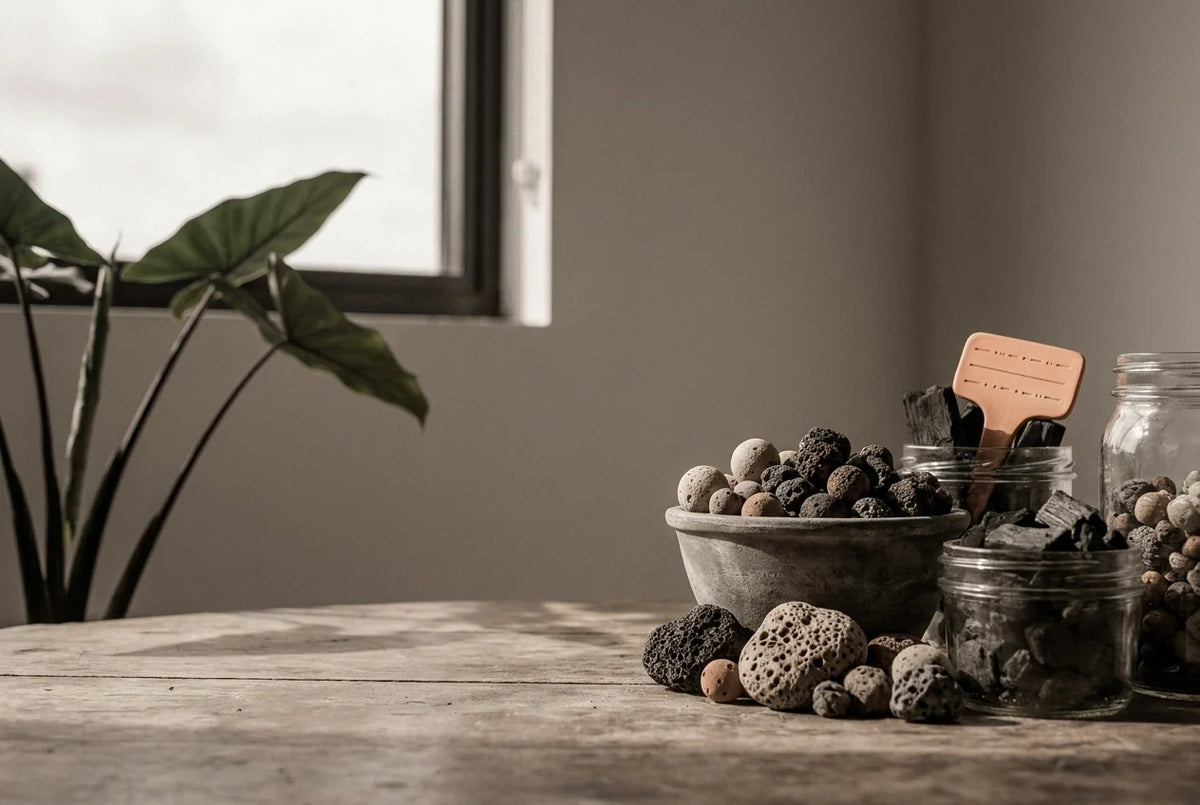
LECA (lightweight expanded clay aggregate) is the starting point for most UK growers, and for good reason. The pebbles are kiln-fired clay expanded into a porous, roughly spherical form that holds moisture within its structure while allowing air to circulate freely between pieces. LECA is widely stocked by UK garden centres and online horticultural suppliers, costs relatively little, and suits the robust root systems of tropical foliage including Colocasia particularly well.
Lechuza-Pon is a finer-grained proprietary mineral blend containing zeolite. The zeolite content is the notable distinction: it holds nutrients within its crystalline structure and releases them gradually, making the substrate more forgiving for growers who feed irregularly. Particle size is smaller than LECA, which suits plants with finer roots. The price per litre is considerably higher, but the nutrient-buffering capacity makes it worth consideration for anyone investing in a more hands-off system.
Pumice alone is a sound alternative for growers who find LECA too coarse. It is lightweight, pH-neutral, drains freely and aerates well. Specialist horticultural suppliers stock it reliably, and it performs consistently without the dustiness that LECA can produce when dry.
Lava rock (scoria) offers similarly good drainage and aeration, but particle sizing varies meaningfully between suppliers. Check the grade before use with smaller-rooted plants, as oversized pieces leave air gaps that fine roots cannot bridge.
One rule applies across all substrates: keep the system purely inorganic. Perlite and bark are sometimes added with good intentions, but both are organic or semi-organic in character and can, over time, compromise the drainage consistency the system depends on. As they decompose, moisture retention increases, and the system begins to replicate the same inconsistency that makes conventional compost unreliable. A true semi-hydro substrate should be stable indefinitely.
Before using LECA for the first time, rinse it thoroughly until the water runs clear, then soak overnight. Rinsing thoroughly and soaking overnight before first use removes dust and debris; many growers also choose to boil or treat with a dilute hydrogen peroxide solution as an additional precaution.
Semi Hydroponics and Colocasia: A Particularly Good Match
Colocasia did not evolve for the sort of growing conditions most houseplants prefer. Colocasia is native to tropical Asia and is well documented as a wetland-margin plant, accustomed to saturated soils and high moisture availability. The roots are accustomed to reaching down into waterlogged ground. Moisture is not a luxury; it is an expectation.
That origin shapes how Colocasia behaves in a pot. The roots actively extend toward water rather than waiting for it to arrive, which makes them unusually well suited to a passive wicking system. Given the opportunity, they will grow directly into the reservoir zone of a semi-hydro planter, drawing moisture steadily upward through the substrate in precisely the way the method is designed to encourage.
The problem in conventional compost is that this same affinity becomes a liability. Enthusiastic growers, sensing that Colocasia likes water, tend to overdo it. Compost stays wet, oxygen disappears from the root zone and rot follows quietly. Pull back too far in the other direction, and the plant responds with equal speed: leaf edges scorch, older growth yellows and, in a heated British sitting room in February, the plant may abandon the season entirely and retreat into dormancy weeks before it should.
In our early growing work at Fullness of Time, some semi-hydro Colocasia have held foliage well into the darker months. That is an observation from a developing nursery system, not yet the result of a controlled comparison with compost-grown plants.
Other high-humidity tropical foliage responds well to the same system. Alocasia, Caladium and certain moisture-loving Philodendron species all benefit from the stable root conditions semi-hydroponics provides. Colocasia, though, given its particular preference for wet ground, sits closer to the natural end of this spectrum than almost anything else commonly grown as an indoor plant in the UK.
Semi Hydroponics in the British Home: Practical Realities
Growing these plants well in Britain means reckoning with two domestic realities that most semi-hydro guides, written for American audiences, ignore entirely: the hardness of our water and the particular cruelty of a British winter.
Much of England, including the Midlands and the South, sits over chalk and limestone geology. The Drinking Water Inspectorate classifies water above 200 mg/l of calcium carbonate as hard, and a large part of the country, Worcestershire included, falls into that category or beyond it. Over time, that calcium and magnesium deposits as a white crust in any substrate. The advantage semi-hydro holds here is straightforward: mineral salts sitting in open-structured LECA or Lechuza-Pon can be flushed out cleanly with a thorough rinse. The same salts trapped in compacted, degrading compost are far harder to displace. Where possible, use collected rainwater, filtered water or reverse-osmosis water for both reservoir top-ups and periodic flushes. It makes a visible difference to substrate longevity and is particularly worth the effort for sensitive tropical foliage.
The second challenge arrives in October and does not leave until March. Central heating draws moisture from the air, ambient light drops sharply, and tropical plants respond by slowing almost to a standstill. Reservoir refill intervals that ran to ten days in August can stretch to three weeks or more by December. This is not necessarily a problem, but the reservoir should be checked less often by habit and more often by the plant’s actual uptake.
Positioning matters more in winter than at any other time. Place semi hydroponic houseplants on the brightest windowsill available, but keep them clear of direct radiator heat, which desiccates foliage quickly. Grouping several plants together raises the local humidity modestly around all of them. In rooms where heating is intense, a small humidifier makes the most practical difference.
Feeding Semi Hydroponic Plants: What Changes and What Stays the Same
Water addresses itself in winter, but feeding requires more deliberate thought.
Inorganic substrates, whether LECA, pumice or a proprietary blend, contain no inherent nutrition whatsoever. Peat and bark composts release modest amounts of nutrient as they decompose; an inorganic medium does nothing of the sort. Every milligram of nutrition your plant receives must come from fertiliser added to the reservoir water. This is not a disadvantage so much as a transparency: you know precisely what the plant is receiving, rather than guessing at what the compost is or is not contributing.
Use a balanced, water-soluble fertiliser formulated for hydroponic or semi-hydro use rather than adapting a soil-based feed. Apply it at roughly half the concentration recommended on the label for soil-grown plants. The reason for this caution is salt accumulation: in compost, excess minerals are diluted and displaced with each watering; in a closed reservoir system, they concentrate in the substrate over time and can damage roots if left unchecked.
To manage this, flush the substrate thoroughly periodically, practitioners commonly suggest every few weeks. Pour clean water directly through from above until it runs freely from the drainage holes, then allow the planter to drain before refilling the reservoir with fresh, dilute nutrient solution. This single habit prevents most of the mineral build-up problems that growers encounter when feeding semi hydroponic plants indoors.
For Colocasia and other large-leaved tropicals, lean toward a slightly higher nitrogen ratio during the active growing season from spring through midsummer, then shift to a more balanced or lower-nitrogen formulation as growth slows in autumn. Pushing nitrogen through the winter encourages soft, vulnerable growth at exactly the point when light levels cannot support it.
One practical consideration for newer growers: zeolite-containing substrates such as Lechuza-Pon are widely reported by practitioners to buffer nutrients more forgivingly than plain LECA, which offers no equivalent reserve. If your feeding schedule is likely to be irregular, this difference is worth weighing when choosing your substrate.
Why Planter Design Matters for Semi Hydroponic Systems
Getting the feeding regime right matters, but it only works if the planter itself is doing its part. Substrate chemistry and nutrient balance count for little if the container beneath the plant is poorly proportioned or gives no indication of what is happening in the reservoir below.
A semi-hydroponic planter needs three things to function properly: an inner pot or net pot that suspends the substrate above the waterline, a defined reservoir space beneath it, and some means of reading the water level without disturbing the plant. That last detail matters more than it sounds. Lifting a planted container to gauge weight, or removing an inner pot to peer inside, introduces exactly the kind of unnecessary disturbance that passive systems are designed to avoid.
The air gap between the base of the substrate and the water surface is not incidental. Roots should descend into the reservoir zone by their own inclination, finding water as they explore. Roots that sit permanently submerged encounter reduced oxygen, the same anaerobic conditions discussed in the failure-points section above. Research on oxygen diffusion confirms that it moves roughly ten thousand times more slowly through water than through air, which is why that unsubmerged zone is not a design nicety but a functional requirement.
The difficulty for UK growers is that most available hydroponic planters are designed for commercial production: utilitarian shapes, clinical plastics, visible piping. They work, but they look entirely out of place in a considered domestic interior where a Colocasia in full growth deserves better company.
This is the gap that Fullness of Time's planter range addresses directly. The designs are built around semi-hydro geometry from the outset, with reservoir proportions, drainage geometry and a visual character drawn from Victorian glasshouses and the tradition of serious botanical collections. The aesthetic is substantial rather than disposable, and the reservoir is readable at a glance.
A reliable method depends on every component holding its place. A planter that makes the reservoir visible and maintains the correct root-to-water relationship removes the last point of uncertainty, and with it the last reason to hesitate.

Converting an Existing Plant to Semi Hydroponics
Once the planter is chosen and ready, the question becomes how to move a plant that has spent its life in compost across to an entirely different growing environment.
Spring is the most commonly recommended moment for this, when rising temperatures and returning light coincide with active root growth in most tropical foliage. A plant pushing new leaves in April has considerably more resilience than the same plant sitting quietly dormant in January.
The process itself is straightforward. Remove the plant from its pot and shake away as much compost as you can by hand, then rinse the remaining soil from the roots under lukewarm water until they are clean. Cold water can shock roots that are already being disturbed, so take a moment to let the tap run warm before you begin. Once clean, examine the roots carefully and trim away anything soft, brown or clearly damaged using clean scissors or snips. Allow the plant to rest for twenty minutes or so before potting it into your pre-soaked substrate, which gives cut surfaces a brief chance to dry and reduces the risk of introducing rot to the new medium.
Some adjustment after conversion is normal. Soil-adapted roots and the finer water-seeking roots that semi-hydro conditions encourage are not quite the same structure, and the plant may pause its growth or drop a leaf or two while it acclimatises. This is not a sign that something has gone wrong; it is the plant redirecting its resources. Resist the urge to intervene.
During this settling period, fill the reservoir to roughly a quarter of its total capacity rather than the full level. This encourages roots to explore downward through the substrate in search of moisture rather than sitting passively above a standing pool.
Colocasia's affinity for wet conditions means it generally takes readily to the passive reservoir system, and in a warm, bright spot, vigorous new growth often follows within a few weeks of conversion.
Common Questions About Semi Hydroponic Houseplants

A few practical questions come up reliably once growers have understood the method and are weighing whether to commit.
Is it expensive to set up? The initial outlay is higher than a bag of multipurpose compost and a plastic pot, yes. But inorganic substrates do not degrade or require annual replacement the way compost does. LECA can be rinsed and cleaned between uses, and many growers report reusing it successfully over long periods, which reverses the cost equation considerably over time.
Can all houseplants be grown this way? No. Many tropical foliage plants can adapt well, but results depend on species, root condition, substrate, reservoir design and the conversion process. Plants adapted to dry or sharply drained conditions, including many succulents and cacti, are generally poor candidates for a standing reservoir.
What about algae in the reservoir? Green algae can develop where light reaches nutrient solution, particularly near bright windowsills. An opaque outer container reduces the risk considerably. If algae appears, clean the reservoir, flush the substrate and reduce light reaching the water.
Will it solve fungus gnat problems? Replacing moist organic compost can greatly reduce the breeding habitat available to fungus gnats, but it does not make the wider growing area immune. Algae, decaying roots and nearby organic media can still support them.
What if feeding goes wrong? Empty the reservoir, flush the substrate thoroughly and restart with a weaker nutrient solution. Salt accumulation can damage roots, so concentration and periodic flushing matter even in a passive system.
A More Reliable Way to Grow Indoors

The method's strengths, covered in detail above, converge on a simple outcome: a more stable, lower-maintenance growing environment that matches tropical plant biology.
Fullness of Time is developing semi-hydro planters around reservoir visibility, root aeration and practical use with tropical foliage. Those products remain in development and will be released only after the prototypes have been tested with real plants.
For the plants themselves, browse our Colocasia collection or compare cultivars such as ‘Coffee Cup’ and ‘Black Coral’. The individual pages explain the plant’s form, current status and growing notes.
In the fullness of time, a plant well set up at the start rewards the grower at every stage that follows.
Conclusion
Semi-hydroponics is worth considering when its controls suit the plant and the grower. Start with one plant, record reservoir level and nutrient strength, and treat the first conversion as a measured trial rather than a guaranteed cure.
A plant given the right foundation from the start will reward that decision at every stage that follows.

Leave a comment
This site is protected by hCaptcha and the hCaptcha Privacy Policy and Terms of Service apply.