Choosing a Semi Hydroponic Substrate: What Actually Works for Tropical Foliage
Short answer: which substrate works best for semi-hydroponics? LECA is reusable and gives strong aeration, while mineral mixes such as PON offer finer capillary action and more weight. The best choice depends on root size, reservoir design and maintenance routine.
Most growers setting up a semi hydroponic system spend considerable time choosing the right pot, the right reservoir depth, the right fertiliser ratio. Then they fill the container with whatever inert substrate is most readily available and assume the job is done. It rarely is.
The semi hydroponics substrate you choose is not a secondary consideration. It governs moisture retention and root aeration at the same time, two demands that frequently pull in opposite directions. For tropical foliage plants, and for Colocasia in particular, the margin for error is narrow. The wrong material does not just underperform; it fails in specific, predictable ways that are worth understanding before you invest in a system.
This piece works through the full substrate picture: how different materials behave, where each one falls short, and what our documented trials here in Worcestershire have actually shown under real British growing conditions. By the end, you will have a clear, evidence-based framework for choosing a substrate that genuinely suits your plants rather than one that merely looks the part.

The Two Things a Semi Hydroponic Substrate Must Do Simultaneously
A semi hydroponic substrate must accomplish two things at once, and the difficulty is that they pull in opposite directions. At the base of the pot, where particles meet the reservoir, the substrate must draw moisture upward reliably and maintain continuous capillary contact with the water below. Simultaneously, in the root zone above that line, it must hold enough open structure to keep air circulating around the roots. Moisture retention and root aeration are not naturally compatible properties, and most general-purpose growing media are engineered to serve one at the expense of the other.
Standard potting compost retains moisture well but compacts, excludes air and decomposes. Coarse horticultural grit drains freely but wicks almost nothing from a standing reservoir. Neither delivers both criteria together, which is precisely why semi hydroponics requires a substrate evaluated against its own distinct standards, not borrowed logic from conventional container growing.
The reservoir line is where this tension becomes consequential. It marks the boundary between the standing water below and the rooting column above, and substrate behaviour at that boundary determines whether the system functions or slowly fails. Particles that wick too aggressively draw saturation upward into the root zone. Particles that are too coarse maintain a dry gap that roots cannot bridge. The reservoir line is not an engineering abstraction; it is the single point in the system where moisture and aeration must be balanced simultaneously by the substrate itself.
Tropical foliage plants are particularly unforgiving of compromise here. Their roots require reliable oxygen availability and are sensitive to prolonged saturation in ways that, say, semi-aquatic or succulent species are not. Colocasia in particular, despite its appetite for moisture, will decline steadily in a substrate that has sacrificed aeration for water retention, with the damage often invisible until it is well advanced.
Every material evaluated in the sections that follow is measured against these two criteria. That consistency is the only framework that produces reliable conclusions.
Why British Growing Conditions Change the Calculation
Those dual criteria do not operate in a vacuum. Apply them in a Worcestershire sitting room in January and you are working with a set of ambient conditions that most substrate guidance was never written to address.
Water hardness across much of England and Wales is substantial by international standards, with hard and very hard supplies common across the Midlands, South East and East Anglia. Over weeks and months, calcium and magnesium deposits can accumulate on inert substrate particles, forming a pale surface crust, which in our experience contributes to pH drift and reduced nutrient availability, symptoms that are easy to misread as feeding problems rather than substrate ones.
Central heating compounds this considerably. British homes in winter are routinely drier than a continental greenhouse, and that low ambient humidity places continuous capillary demand on whatever substrate sits above the reservoir line.
Temperature matters too. A Midlands windowsill in February can drop to genuinely cool temperatures overnight, and at those temperatures root metabolism slows. Slower roots are less tolerant of poor aeration, meaning a substrate that performs acceptably in summer warmth can tip towards suffocation in autumn without any change in watering habit or reservoir level.
Reduced winter light lowers transpiration rates, so the substrate cycles between wet and dry more slowly. That extended wet period at the reservoir interface is precisely where compaction and oxygen depletion become problems.
Read any semi hydroponic guide that was written for Florida summers or Dutch controlled glasshouses with all of this in mind.
How Substrates Fail: The Mechanisms Worth Understanding
Understanding the specific ways a semi hydroponic medium can fail is what separates genuine diagnosis from guesswork.
Waterlogging failure is the most common, and the most damaging. Some materials wick reservoir moisture aggressively upward through capillary action, pulling water higher into the particle column than the root zone can tolerate. The result is a chronically saturated zone where roots have no opportunity to dry between cycles. Tropical foliage roots need intermittent air contact; denied it consistently, they suffocate quietly and the grower, seeing a full reservoir and green leaves, often looks elsewhere for the cause.
Excessive drainage failure is the opposite problem and nearly as frustrating. Certain substrates are so free-draining that meaningful capillary contact with the reservoir never establishes. The material above the waterline stays effectively dry. Roots develop at the reservoir interface and nowhere else, the plant becomes structurally dependent on a narrow band of moisture, and any drop in reservoir level leaves it in conditions closer to neglect than semi hydroponics.
Compaction failure tends to declare itself slowly. Lighter or irregularly shaped particles settle under their own weight and under the pressure of root growth over a growing season. Air pockets close. What began as an open, aerated column gradually consolidates into something approaching a solid plug. The substrate may look unchanged from above while the root environment has fundamentally altered beneath the surface.
pH drift failure is less visible still. Substrates that are not genuinely chemically inert release compounds into the nutrient solution over time, shifting the pH incrementally and interfering with the precise chemistry that tropical foliage roots depend on for mineral uptake.
Recognising these four failure modes matters because the symptoms they produce overlap considerably with those of poor watering practice. A grower who understands them will look at the substrate first.
LECA: The Default Choice and Its Real Limitations
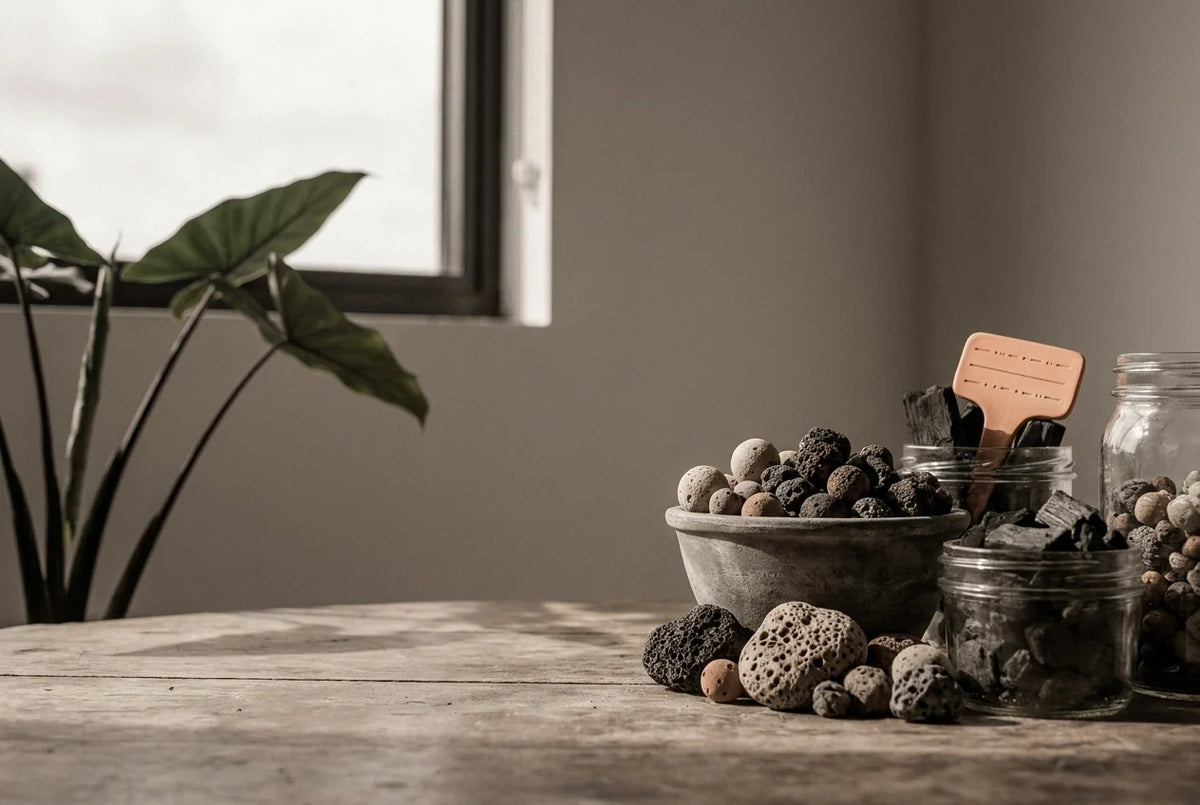
Fired expanded clay aggregate is genuinely inert, structurally stable and widely available in the UK from aquatic and hydroponic suppliers. It holds its shape, maintains good air space between particles and does not decompose, qualities that disqualify several of the failure modes described above.
The limitation most guides overlook is that LECA is not a single material in any meaningful practical sense. Grade varies considerably between suppliers, and that variation directly governs moisture behaviour. Smaller-grade pellets present more contact surface between particles and wick reservoir moisture higher into the pot column, which suits moisture-loving species but risks the kind of persistent saturation that tropical roots resent. Larger-grade pellets drain more freely, preserve air space generously and reduce capillary travel, but their contact with the reservoir can be insufficient to sustain roots during the drier phases between top-ups. Matching grade to pot depth and plant genus is more consequential than most purchasing decisions acknowledge.
There is a subtler limitation in LECA's physical character. The smooth, vitrified surface of a fired clay pellet offers very little texture for beneficial microorganisms to colonise. In a purely inert, nutrient-solution-fed setup this matters less, but growers who work with biological additives or inoculants will find those populations establish more slowly and less durably on LECA than on more irregular or porous materials.
On chemistry, LECA's reputation is well earned. Properly pre-soaked and thoroughly rinsed before use, it contributes nothing measurable to pH and remains predictable across nutrient solution changes, which simplifies feeding management considerably.
Longevity is the honest argument in LECA's favour. Quality pellets cleaned, sterilised and re-rinsed between growing cycles retain their structural integrity across several seasons. The upfront cost, which can seem steep against a bag of bark, distributes across those cycles into something considerably more modest.
Bark and Chunky Organic Mixes: Useful but Not Truly Inert
Orchid bark and similarly textured chunky organic blends have a genuine following in semi hydroponic communities, largely because they look natural, handle well and initially perform reasonably. The problem is classification: bark is not an inert substrate. It is a biological material in slow decline, and that decline is not neutral. It decomposes, compacts and alters the chemistry of whatever nutrient solution surrounds it, all of which work against the stability a semi hydroponic system depends upon.

Fresh bark is the most disruptive phase. Tannins leach readily from new material, acidifying the nutrient solution in ways that are difficult to measure without regular pH testing. For a heavy feeder like Colocasia, tannin-driven acidification can interfere with nutrient uptake, a particular concern for heavy feeders like Colocasia that draw heavily on the nutrient solution. A grower who attributes yellowing or poor growth to incorrect feeding may simply be watching the bark undermine the nutrients they are already providing.
Decomposition then accelerates sharply at the reservoir interface, where warmth and constant moisture combine to create near-ideal conditions for microbial breakdown. Bark used in a conventional potting mix degrades slowly because it spends periods drying out. In a semi hydroponic setup, the lower portion of the substrate never truly dries, and breakdown proceeds accordingly. Six months is a realistic functional ceiling for bark-based semi hydroponic media in a warm British interior.
For growers who prefer some bark in the mix, blending with a genuinely inert material at roughly equal proportions by volume can extend workable lifespan and moderate tannin concentration. It does not stop the clock, but it slows it. Plan the replacement nonetheless.
Perlite and Combination Substrates: Where the Nuance Lives
If bark sits at one end of the organic-to-inert spectrum, perlite sits at the other, and neither extreme serves a semi hydroponic setup especially well on its own.
Used alone, perlite drains almost immediately. Its low bulk density means it holds very little water against gravity, and the capillary action it does possess depends heavily on particle grade; coarse horticultural perlite, which is what most UK suppliers stock, offers minimal wicking at the reservoir interface. A plant sitting in pure perlite is effectively in a free-draining medium that dries out between any meaningful contact with the reservoir. For tropical foliage, that is a structural problem rather than a recoverable one.
Where perlite earns its place is as a blending component. Mixed into LECA at roughly twenty to thirty per cent by volume, it opens up the air space between larger particles without undermining the structural support that keeps root systems anchored. The exact proportion requires adjustment: shallower pots with lower reservoir depths benefit from slightly more perlite, deeper vessels with longer wicking columns less so. There is no universal ratio, and growers who arrive at a working blend should measure it accurately rather than eyeballing it each time.
The floating problem is real and worth acknowledging directly. Perlite is a glassy volcanic material of very low density; in our experience it rides to the surface whenever flooded and redistributes during top-watering if denser particles are not present to hold it in the column. A well-structured LECA base manages this reasonably well, but it is worth being deliberate about layer placement.
From a practical standpoint, pumice is a useful alternative for growers who can source it. It appears denser than perlite in use and tends to stay in place when wet, though comparative data is limited. Horticultural pumice is harder to find through mainstream UK suppliers, though specialist online retailers do carry it in appropriate grades.
The broader caution with any combination substrate is consistency. Mixed by eye, ratios shift between repotting cycles, and performance shifts with them. When a plant declines, inconsistent substrate is one of the harder variables to isolate if no record was kept of what went in.
Sphagnum Moss in Semi Hydroponic Systems: A Specific Use Case
Sphagnum sits in a different category from the materials discussed above. It is not inert, not neutral, and not well suited to a permanent semi hydroponic setup, yet it appears often enough in online advice that it deserves a clear account of where it works and where it does not.
The first problem is pH. Sphagnum creates a naturally acidic environment that sits outside the neutral-to-slightly-acid range Colocasia prefers. Over time, that acidity influences the nutrient solution and can interfere with calcium and magnesium uptake, two elements Colocasia draws on heavily.
The second problem is wicking behaviour. In a reservoir system, sphagnum can keep the entire root zone in a state of chronic dampness regardless of how carefully the reservoir level is managed. The result mimics overwatering, and the roots respond accordingly.
The third problem is compaction. Sphagnum loses its structural openness over a growing season as fibres break down and compress under the weight of a developing root system. What begins as a loose, airy medium gradually becomes a dense, moisture-retaining plug with little meaningful air space remaining.
Where sphagnum genuinely earns its place is as a transitional medium. For cuttings or recently divided plants moving from soil or water propagation into a permanent inert substrate, a short period in moist sphagnum can support root establishment before the final move. This is a temporary role, not a long-term one.
On sustainability, UK growers should be aware of ongoing industry guidance on responsible growing media choices and, where sphagnum is used, favour certified responsibly sourced long-fibre material. Peat-free alternatives are worth considering wherever the growing situation permits.
What Our Worcestershire Trials Have Shown
All of the theoretical discussion above resolves, eventually, into something more useful: what actually happened when these materials were put in front of real plants, in a real house, in the English Midlands.
Our trials have run across consecutive growing seasons in a Worcestershire interior, with conditions that will be familiar to most UK growers. Central heating reduces ambient humidity sharply between October and April. Tap water here is moderately hard. Natural light drops considerably from late autumn, slowing transpiration and altering how quickly substrates cycle at the reservoir interface. These are not laboratory conditions, and we make no claim that they are.
The evaluation framework we applied held two targets simultaneously: approximately 35% moisture retention and approximately 40% air space at the root zone. Materials that achieved one at the cost of the other were set aside. The point was not theoretical elegance but practical function, sustained over a full growing season and into the next.
The six-month mark emerged as a consistent diagnostic threshold. Several materials that performed acceptably in their first season showed measurable compaction and structural degradation by this point, with plant performance declining in step. Root systems in compacted substrates became stunted and pale, showing the fine-root dieback that indicates oxygen starvation at the zone above the reservoir line. In contrast, Colocasia grown in substrates that maintained structural integrity through this period produced vigorous, pale-cream root systems that spread throughout the container rather than clustering near the base.
These are primary observations, not peer-reviewed data, and we think that distinction matters. A controlled trial answers a narrow question under ideal conditions. Observations from a real growing environment answer the question a grower in a similar situation actually faces. The correlation between substrate choice and root development in our Colocasia was consistent enough to inform the recommendations that follow with reasonable confidence, while remaining honest that your own conditions will introduce variables we cannot fully anticipate.
Substrate Recommendations for Colocasia in Semi Hydroponic Systems
What those trials point towards, for Colocasia specifically, is a fairly clear set of material requirements that differ in emphasis from general tropical foliage guidance.
The genus is a large, vigorous plant when grown well, and the substrate must provide genuine structural anchorage as well as the dual moisture and aeration performance required of any semi hydroponic medium. A light or friable material that performs adequately for a small aroid will shift and compress under the weight of a mature Colocasia corm and its root mass, undermining the stability that keeps both plant and planter functioning correctly.
Colocasia shows practical tolerance for slightly higher reservoir levels than many aroids, consistent with its preference for moisture-rich conditions, though this should not be read as permission to keep roots in standing moisture indefinitely. If the substrate above the reservoir line cannot cycle through a meaningful dry phase between replenishments, the root zone loses the intermittent aeration it needs, and the familiar signs of oxygen stress follow regardless of how moisture-hungry the species is.
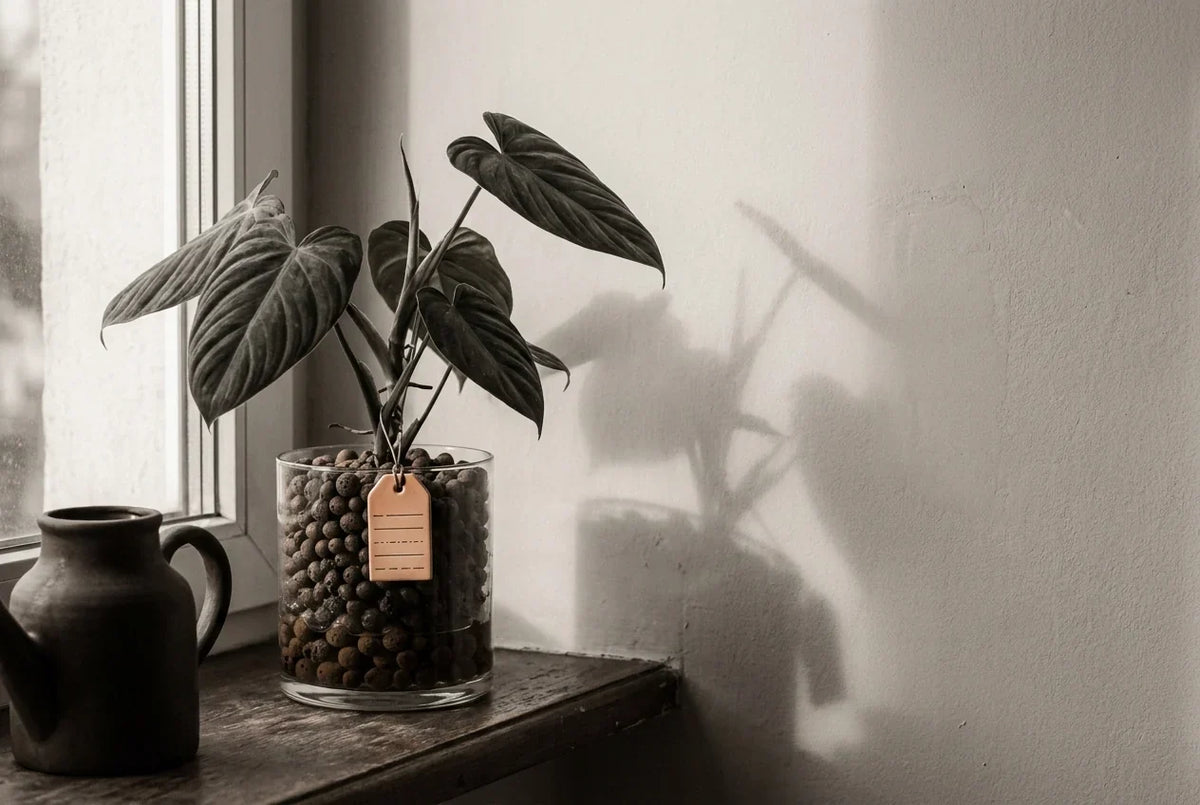
Medium-grade LECA, properly pre-soaked and rinsed, allows capillary moisture to travel upward to the root zone while the upper particle column dries sufficiently between cycles. Finer grades wick too high and too persistently; coarser grades lose meaningful reservoir contact. Based on our own trials with pots in the 15 to 25 centimetre diameter range, a reservoir held at roughly 20 to 25 percent of total pot depth has given reliable results with medium-grade LECA, though exact proportions will vary with your specific vessel geometry.
Our developing substrate formulation has been shaped directly by these Colocasia observations, refining particle size distribution and blending for the weight and aeration demands the species places on a semi hydroponic medium. Growers who prefer a tested, ready-proportioned option can find details in our growing products range.
Substrate Longevity, Reuse and the Cost of Getting It Wrong

Choosing a substrate well is only half the task. What you do with it over the following seasons determines whether that initial decision holds its value.
Inert materials like LECA have a genuine longevity advantage over organic components, but they are not maintenance-free. Hard water in much of England and the Midlands deposits calcium and magnesium salts onto pellet surfaces with each watering cycle, and root dieback leaves organic residue in the particle gaps. Left unaddressed, both accumulate into a substrate that looks unchanged but performs quite differently from when it was new.
The reuse protocol is straightforward. Remove the plant, flush the substrate thoroughly with clean water, then pick out visible root matter by hand or with a fine sieve. We use roughly one part three-percent peroxide to four parts water, though exact concentrations vary by preference; soak the pellets in this dilute hydrogen peroxide solution for 24 hours to sterilise. Rinse thoroughly, twice if you are using hard tap water, and allow to drain fully before replanting. Rinsing outdoors is sensible; the clay dust and mineral residue released during cleaning will block domestic drains over time.
On cost, the comparison is less straightforward than it first appears. Quality LECA carries a higher upfront price than a bag of bark-based mix, but, as the six-month threshold established in our trials suggests, bark-based media need replacing considerably sooner. LECA, maintained properly, remains functional across multiple growing seasons. The cost-per-cycle difference becomes substantial when you factor in the labour of repotting and the disruption to the root system each replacement causes.
Signs that a substrate has genuinely exhausted its life: particles have visibly broken down or compacted, a persistent sour odour remains after thorough flushing, or plant health continues declining despite correct feeding and reservoir management. At that point, no amount of cleaning will recover it.
Build a substrate review into your growing calendar, autumn being the natural moment before winter slows root activity. It is a modest habit that prevents the slow, undiagnosed decline that catches many growers out well before they think to check the substrate at all.
Making the Right Choice for Your Setup
The practical test is simple: does this material deliver moisture retention and root aeration simultaneously, in a British home, through the full range of seasons?
The difference between materials is large enough to explain success or failure entirely. A grower who attributes persistent root problems to feeding, watering frequency or pot size may simply have the wrong substrate. Everything else in a semi hydroponic setup, the reservoir depth, the nutrient concentration, the planter geometry, operates within boundaries the substrate sets. Choose poorly and those adjustments are compensations, not solutions.
What no guide can supply, including this one, is your windowsill in October, your water hardness, the output of your particular radiator. Document what you observe across the first growing season: root development, any signs of waterlogging or desiccation, how the substrate looks and smells when you inspect it. Those notes will tell you more than generic advice, and they accumulate into real knowledge rather than borrowed confidence.
Fullness of Time's substrate and semi hydroponic planter range has been shaped by exactly this kind of patient, documented observation. If you would prefer to begin with a tested formulation rather than work through the variables yourself, it is there as a practical starting point.
Conclusion
Substrate choice is not a minor detail in semi hydroponic growing; it is the variable that determines whether everything else works. The right material must anchor roots, manage moisture and remain structurally stable across an entire growing season. British conditions, particularly low light and cool temperatures, tighten the margin for error considerably.
Medium-grade LECA offers the most dependable foundation for most tropical foliage, including Colocasia. Combination substrates have their place, but only when the reasoning behind them is sound. And whatever you choose, document your results. One honest growing season of observation outweighs any amount of secondhand advice.
If you want to skip the trial-and-error phase, explore the Fullness of Time semi hydroponic planter and substrate range. Built from genuine field testing, it gives you a proven starting point so your attention can go where it belongs: watching your plants thrive.

Leave a comment
This site is protected by hCaptcha and the hCaptcha Privacy Policy and Terms of Service apply.