
Taro in Ancient Agriculture and Its Enduring Legacy
To speak of taro in ancient agriculture is to open a cabinet of living history, one filled not with dusty labels but with broad, rain-polished leaves and corms that fed whole communities. Long before the glasshouse, the online nursery and the collector’s wish list, taro stood in warm valleys, wet gardens and island settlements as a crop of consequence. For those of us who admire Colocasia today for its veining, posture and theatrical foliage, its antiquity lends the plant a certain gravity. It is not merely decorative. It is a descendant of fields, hands, water channels and patient observation, brought forward into modern horticulture with all the quiet dignity of a well-travelled botanical curiosity.
Why taro in ancient agriculture mattered
Botanically, taro is most commonly associated with Colocasia esculenta, a member of the Araceae family. Britannica describes taro as a tropical plant cultivated for its starchy underground corms, although its great heart-shaped leaves are what first seize the attention of many modern growers. In old cultivation, however, beauty was not the primary affair. Food, reliability and adaptability were the plant’s credentials.
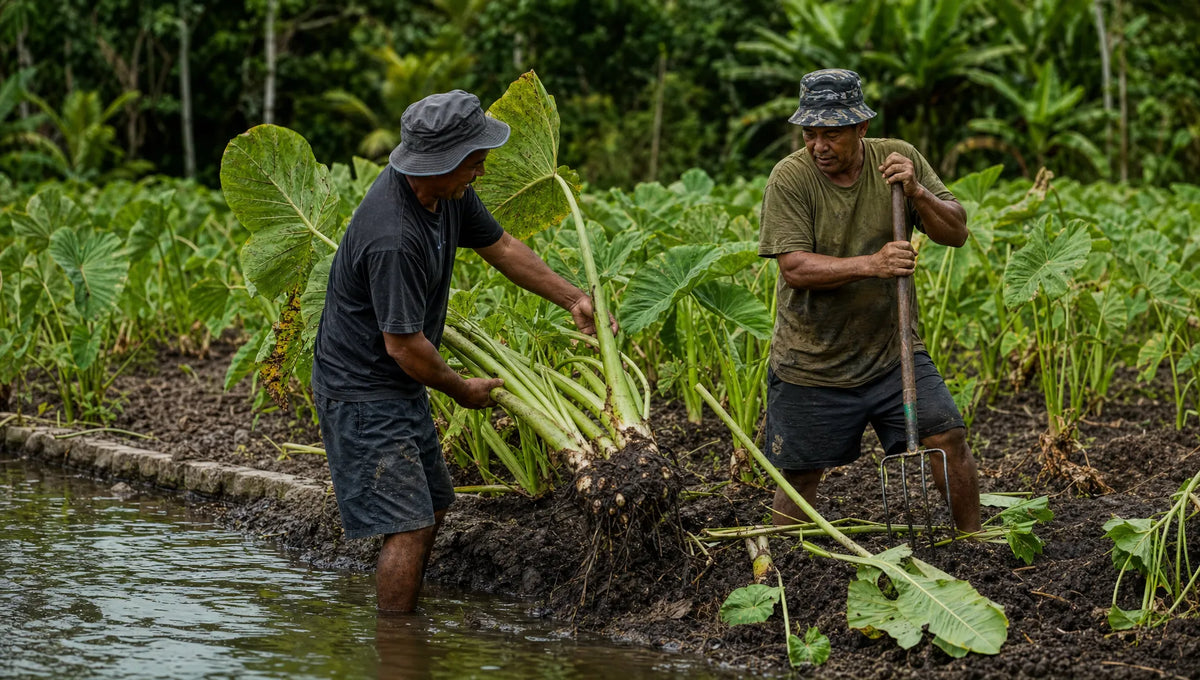
Unlike cereal crops that favour open dry fields, taro found its strength in places many plants would find troublesome: stream margins, damp hollows, humid forest edges and carefully managed wetlands. It could be grown in flooded or semi-flooded systems, yet also in upland gardens where rainfall and soil structure were favourable. This gave early cultivators options, and options are the first luxury of agriculture.
Taro’s value lay partly in its corm, a substantial store of carbohydrate that could sustain households where grain was not always the obvious answer. The leaves were also used as food in many traditions, though always with proper preparation because raw taro contains irritating calcium oxalate crystals. The practical brilliance of taro in ancient agriculture was that it converted warmth, water and human care into dependable nourishment.
Wet gardens, New Guinea and the old art of managed land
One cannot discuss this plant’s deep past without pausing at New Guinea, whose highland wetlands have become central to modern understanding of early cultivation. UNESCO’s Kuk Early Agricultural Site records evidence of drainage, plant exploitation and agricultural development dating back 7,000 to 10,000 years. It is one of the great places on the map where agriculture appears not as a borrowed fashion but as an independent human achievement.
The archaeological story is not as tidy as a seed catalogue. Aroids and corm crops rarely leave the same durable traces as wheat or barley. Their tissues decay. Their histories hide in field systems, starch grains, pollen, microscopic residues and the arrangement of ancient ditches. Evidence for taro in ancient agriculture is therefore read through fragments, patterns and landscape engineering rather than a neat basket of preserved tubers.
That makes the achievement more impressive, not less. To cultivate taro well, an ancient grower needed to understand water depth, soil softness, seasonal rhythm and the behaviour of planting material. There was no digital probe in the mud, no fertiliser chart pinned above the bench. There was observation, repeated year after year until land and crop answered each other.
From survival crop to cultural companion
Taro travelled widely through tropical Asia, Oceania and parts of Africa, moving with people who carried useful plants as carefully as stories. In island societies, it became more than sustenance. It entered ritual, kinship, hospitality and status. A well-grown patch could speak of order, generosity and competence.
This cultural weight makes taro rather different from a simple vegetable. It was a crop one tended, selected, divided and passed along. Clones mattered. Local forms mattered. The shape of a leaf, the texture of a corm, the plant’s tolerance of a wet field or drier plot, all could become part of a community’s living knowledge.
For the plant collector, this is a familiar feeling in another guise. The old cultivator selected for food and field performance. The modern enthusiast may select for blackened leaves, raised veins, cup-shaped blades or rare variegation. The motives differ, but the eye for distinction remains. The legacy of taro in ancient agriculture is partly this habit of noticing variation and preserving what is valuable.
Ancient methods with modern lessons for collectors
The old taro garden was not primitive in any meaningful sense. It was a technology of landscape, plant physiology and labour. The tools were simple, but the thinking was sophisticated. A raised bank, a shallow ditch or a diverted trickle of water could alter temperature, oxygen and nutrient flow around the roots.
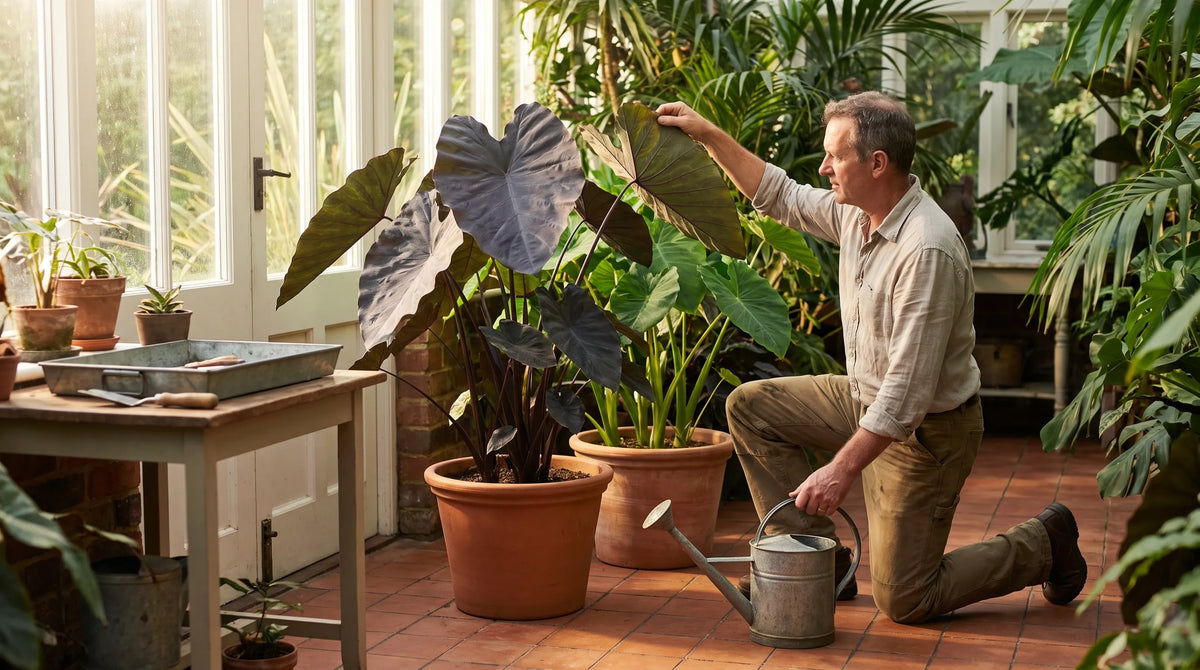
Modern Colocasia growers, whether keeping plants in a conservatory, heated greenhouse or hydroponic system, can still borrow from that ancient discipline. Taro asks us to respect the difference between moisture and stagnation. It enjoys generosity, but cold wet compost is a different kingdom from warm, living soil.
| Ancient growing principle | What it achieved | Modern echo for Colocasia growers |
|---|---|---|
| Warm, humid conditions | Strong leaf expansion and active corm growth | Provide heat, bright filtered light and steady humidity during active growth |
| Managed wet ground | Moisture without complete neglect of air and flow | Keep media evenly moist, but avoid cold stagnant conditions |
| Organic fertility | Slow release of nutrients in living soil | Feed during active growth with a balanced approach rather than sudden excess |
| Division and replanting | Preservation of useful clones | Propagate carefully from offsets or corm divisions when the plant is healthy |
| Seasonal observation | Timing planting and harvest with climate | Adjust watering, feeding and warmth as growth slows or resumes |
The lesson of taro in ancient agriculture is not that every Colocasia should sit permanently in water. It is that the plant responds magnificently when moisture, warmth and oxygen are held in thoughtful balance.

The ornamental turn: Colocasia as living sculpture
In a contemporary British collection, taro’s descendants often arrive not as a sack of corms but as treasured foliage specimens. The transformation is quite marvellous. What ancient farmers valued for sustenance, modern collectors admire for architecture, colour and rarity.
This is where the genus Colocasia becomes especially compelling. Dark leaves, contrasting veins and sculptural posture carry echoes of old utility into a more ornamental age. A cultivar such as Colocasia ‘Aloha’, with its dark foliage and green veining, shows how far the collector’s eye has travelled from the food garden while still remaining within the same botanical circle. The dramatic, raised venation of Colocasia ‘Pharaoh’s Mask’ feels almost archaeological in spirit, as if the leaf itself were carved rather than grown.
For plant collectors, the legacy of taro in ancient agriculture is not a claim that every ornamental Colocasia is an edible crop. Indeed, nursery-grown ornamentals should be enjoyed as plants, not treated as food. The connection is botanical, historical and aesthetic. It reminds us that our rare foliage specimens belong to a lineage shaped by human attention over thousands of years.
What hydroponic and tropical growers can learn
Hydroponic growers may find taro particularly intriguing because it has long been associated with wet cultivation. Yet ancient wetland culture should not be mistaken for careless saturation. A living field has microbial activity, temperature shifts, mineral exchange and moving water. A reservoir, by contrast, depends upon the grower for oxygenation, cleanliness and balance.
For Colocasia under modern systems, the old principles still hold. Roots must be warm. Nutrients must be present but not brutal. Light should be bright enough to support large leaves, yet not so harsh that tender foliage scorches behind glass. Air movement helps keep the atmosphere civilised, especially where humidity is high.
A few practical habits serve the modern grower well:
- Watch the leaves, as droop, pale colour or crisping margins usually speak before the compost does.
- Keep warmth consistent during active growth, particularly at root level.
- Increase watering as leaf mass increases, then reduce it when growth naturally slows.
- Use clean tools when dividing corms or offsets to reduce rot risk.
- Treat each cultivar as an individual, since ornamental selections can differ in vigour and tolerance.
The inheritance of taro in ancient agriculture is a grower’s mindset. It asks for close attention rather than rigid rules, and it rewards those who learn the plant’s season, appetite and temperament.
The enduring legacy in a British glasshouse
There is a pleasing paradox in growing tropical Colocasia in Britain. Outside, the year may be grey and the wind may rattle the panes. Inside, under careful hands, a plant with roots in ancient wet gardens unfurls leaves of almost theatrical scale. It feels less like possession than stewardship.
The old farmers who managed taro were not collecting curiosities, at least not in the modern sense. They were securing food, continuity and cultural meaning. Yet their patience made our present fascination possible. Without centuries of cultivation, movement and selection, the genus would not occupy the same place in our gardens, greenhouses and heated rooms.
In this sense, taro in ancient agriculture is not merely a historical topic. It is present whenever a grower warms a pot, checks the moisture by hand or pauses to admire the geometry of a new leaf. The past has not vanished. It has simply changed costume, stepping from field to glasshouse with remarkable composure.
Frequently Asked Questions
Why is taro in ancient agriculture important? It shows how early societies developed sophisticated wetland and garden systems around a crop that could thrive in warm, moist environments. Taro also helps explain the movement of useful plants through tropical Asia and the Pacific.
Is taro the same as Colocasia? Taro usually refers to Colocasia esculenta, especially when discussed as a food crop. Colocasia is the wider horticultural genus that includes many ornamental cultivars grown for foliage.
Can ornamental Colocasia plants be eaten? They should not be treated as edible unless specifically grown and supplied for food use. Raw taro contains calcium oxalate crystals and food taro requires correct preparation, while ornamental nursery plants are best enjoyed as specimens.
What is the main growing lesson modern collectors can take from ancient taro cultivation? Moisture matters, but so do warmth, oxygen and timing. The finest results come from observing the plant closely and adjusting care as growth changes through the season.
Cultivating the old lineage today
For the collector, Colocasia offers more than grand foliage. It offers a living thread between ancient cultivation and modern botanical enthusiasm. If that thread has caught your fancy, explore the rare tropical plants at Fullness of Time and consider which specimen might next take its place in your own cabinet of living curiosities.
To grow that lineage well in a British home or glasshouse, continue with our complete UK Colocasia care guide.

Leave a comment
This site is protected by hCaptcha and the hCaptcha Privacy Policy and Terms of Service apply.