Plant Names Explained for Rare Tropical Foliage
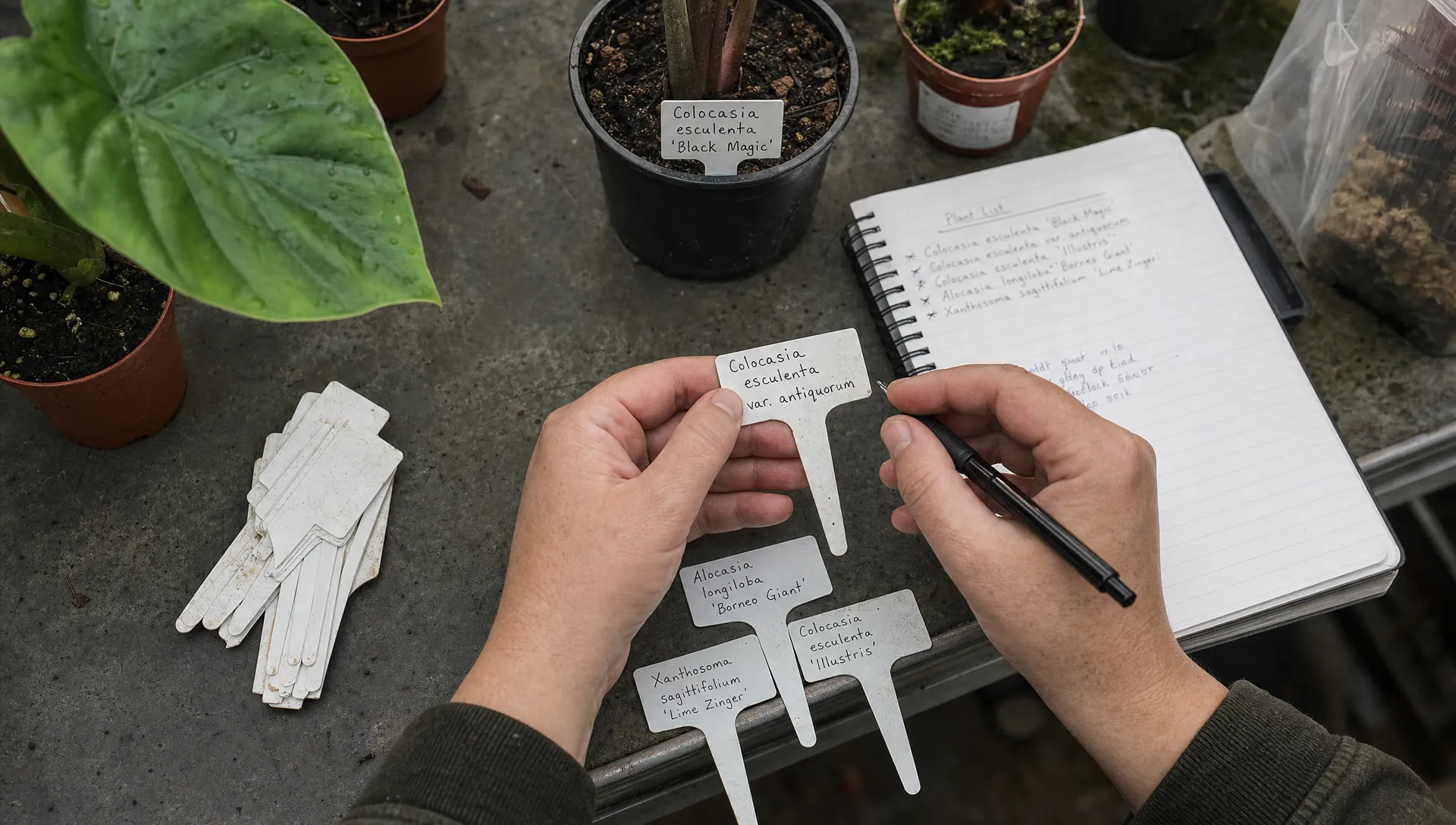
Plant names can look like a private language when you first start collecting unusual tropical plants. A label such as Colocasia esculenta ‘Black Coral’ tells you far more than a casual common name ever could: the plant’s genus, species and named cultivar.
Once you understand how those names are constructed, they become genuinely useful. You can compare plants more confidently, spot vague or questionable listings and keep a much better record of the plants in your collection.
Why plant names matter
Collector plants are often bought for very specific traits: dark leaves, metallic sheen, unusual venation, upright petioles, compact growth or dramatic variegation. Two plants with similar common names can look and behave very differently once mature.
A good plant name is therefore more than a label. It is a record of identity. It helps you compare the plant in front of you with nursery listings, botanical references and your own growing notes.
This becomes particularly important when you start propagating plants. If you divide a rhizome, take cuttings or pass plants to another collector, preserving the correct name helps prevent misidentified plants gradually spreading through collections.
Common names are useful, but limited
Common names are easy to remember and useful in conversation. Elephant ear, taro, prayer plant and velvet leaf can all provide a quick visual or cultural clue.
The problem is that common names are not governed by botanical naming rules. One common name may refer to several different plants, while the same plant can have several common names depending on where it is grown.
This becomes particularly confusing with aroids, where plants from different genera can share very similar leaf shapes and growth habits.
For collectors, the botanical or cultivated name is therefore usually much more useful than the common name alone.
The basic format: genus, species and cultivar
Most plant labels are built from a few recognisable parts.
The genus identifies the broader botanical group, such as Colocasia, Alocasia or Philodendron.
The species narrows the plant further. For example, Colocasia esculenta identifies a particular species within the genus Colocasia.
A cultivar identifies a cultivated selection chosen and maintained for particular characteristics.
| Name element | Example | What it tells you | How it is written |
|---|---|---|---|
| Genus | Colocasia | The broader botanical group | Italicised and capitalised |
| Species | Colocasia esculenta | A recognised species within the genus | Italicised, with the species epithet in lower case |
| Cultivar | Colocasia ‘Black Coral’ | A named cultivated selection | Not italicised and placed in single quotation marks |
| Hybrid | Anthurium crystallinum × Anthurium magnificum | A plant produced by crossing two taxa | The × symbol indicates the hybrid cross |
| Trade designation | Pharaoh’s Mask | A selling or marketing name | May differ from the registered cultivar name |
Cultivar names are often what collectors notice first
In collector horticulture, cultivar names often carry the strongest visual promise. They identify a particular cultivated selection that has been maintained because of its appearance, growth habit or other characteristics.
For example, Colocasia ‘Coffee Cups’ is a named cultivar rather than a broad common-name category.
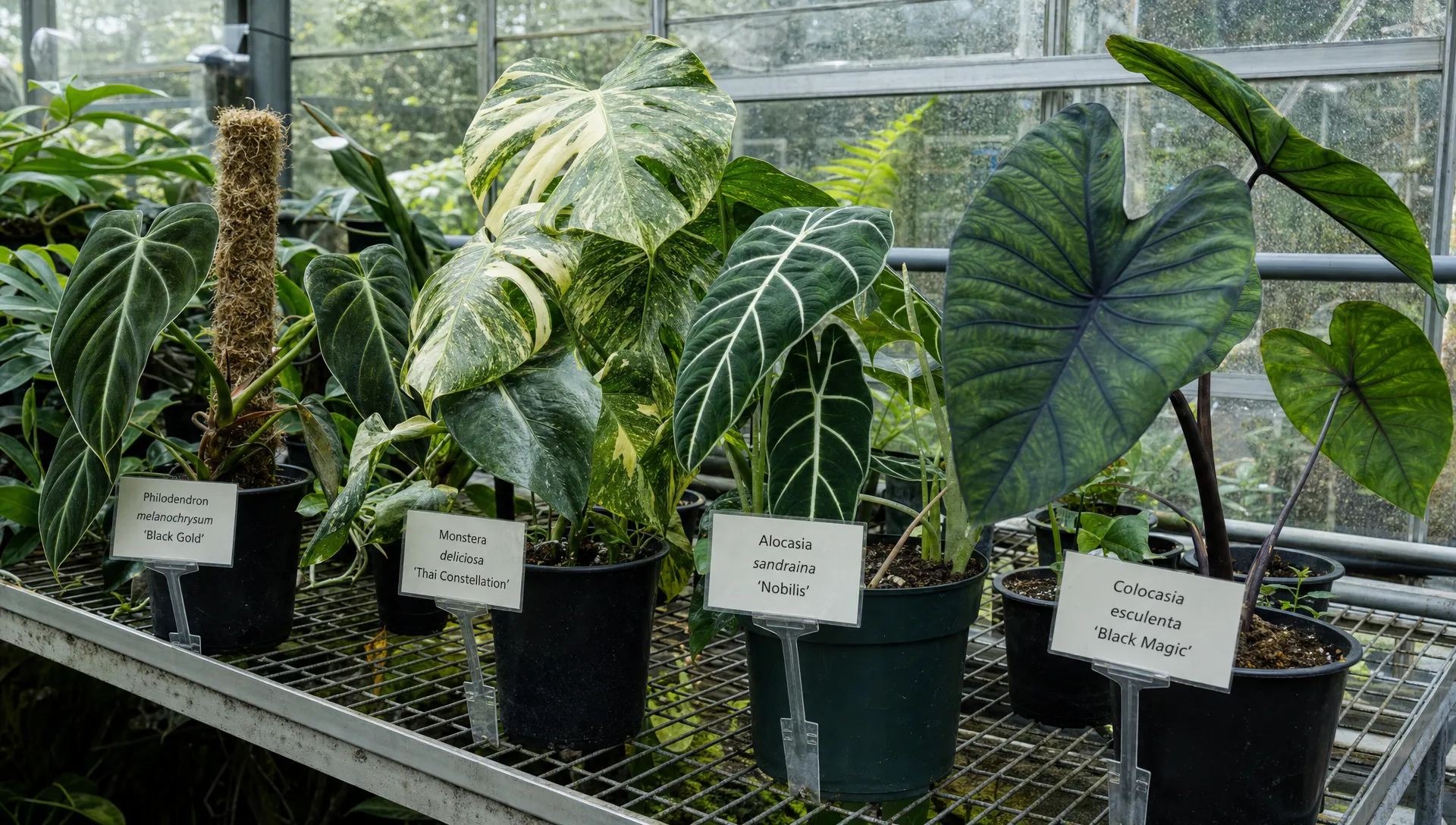
Cultivar names are not italicised. They normally follow the genus or species name and are enclosed in single quotation marks.
For example:
Colocasia esculenta ‘Black Coral’
The botanical portion is italicised. The cultivar name is not.
It is a small formatting difference, but it tells you something important about what kind of name you are looking at.
Species, varieties and forms
Species names are used for naturally occurring plants recognised through botanical taxonomy.
Below species level you may also encounter terms such as subsp. for subspecies, var. for botanical variety and f. for form. These have specific botanical meanings and should not simply be added because a plant happens to look slightly different.
This distinction matters because naturally occurring botanical variation is not the same thing as a cultivated selection.
A seed-grown plant may also vary from its siblings, whereas a cultivar maintained through vegetative propagation should retain the defining characteristics of that cultivar when the stock is true to name.
Hybrids and provisional identifications
Many tropical foliage plants are hybrids. A hybrid can be indicated using the multiplication symbol × between the parent names.
You may also encounter labels such as sp., cf. and aff.. These are useful because they communicate uncertainty rather than pretending an identification is definite.
- sp. means the plant belongs to the stated genus but its exact species has not been confirmed.
- cf. means the plant should be compared with the named species because it appears similar.
- aff. indicates that the plant has an affinity with, or resemblance to, a particular species but may not actually be that species.
When used properly, these labels are not a sign of poor-quality stock. They are an honest description of the level of certainty surrounding the identification.
Trade names, trademarks and selling names
Not every attractive name on a plant label is the formal cultivar name.
Plants may also be sold under trade designations, trademarks, nursery names or descriptive selling names. These can be perfectly legitimate and useful, but they are not necessarily the same thing as a cultivar epithet.
Colocasia Pharaoh’s Mask provides an excellent example.
The plant widely sold and recognised by collectors as Pharaoh’s Mask is associated with the cultivar name ‘Cophama’. Pharaoh’s Mask is the name most growers are likely to encounter commercially, while ‘Cophama’ is the cultivar epithet.
That distinction does not make the familiar selling name wrong. It simply shows why the wording on a plant label can be more complicated than it first appears.
You may also see descriptive labels such as dark form, narrow leaf or silver clone. These can describe useful characteristics without representing formally established cultivar names.
Collectors should therefore be cautious about assuming that every impressive-sounding name represents a recognised cultivar.
How to read a plant name before buying
Reading a plant name on a nursery page does not require botanical training. Start with the genus, then check whether the plant is being sold as a species, cultivar, hybrid or unidentified form.
A few simple checks can prevent confusion later:
- Check whether a cultivar name is shown in single quotation marks.
- Compare the description with the photographs, particularly leaf colour, venation and mature habit.
- Treat sp., cf. and aff. as indications of identification uncertainty rather than confirmed species names.
- Keep a record of the seller, purchase date and exact wording of the original label.
- Be cautious when a rare-sounding name appears without any supporting information or provenance.
For example, Colocasia ‘Mojito’ is a named cultivar.
By comparison, a plant simply sold as Colocasia sp. is telling you that the genus is known but the exact species has not been confidently identified.
Checking plant names without overcomplicating it
It is worth checking plant names when a specimen is expensive, rarely offered or likely to become propagation stock.
For botanical species, Kew’s Plants of the World Online is an excellent reference for accepted names, synonyms and distribution.
The International Plant Names Index is particularly useful for checking published botanical names and their authorship.
Cultivated plant naming follows a different system. The International Code of Nomenclature for Cultivated Plants provides the rules used for cultivar and Group names.
You certainly do not need to memorise these rules to enjoy collecting plants. It is simply useful to understand that there is a recognised system behind the way plant names are written.
If a cultivar does not appear immediately in a botanical database, that does not automatically mean the name is false. Nursery selections and newer introductions may circulate among growers long before comprehensive records become easy to find online.
Why plant names sometimes change
Botanical names sometimes change when taxonomists revise relationships between plants, redefine genera or determine that an older published name has priority.
This can be frustrating when an old book, nursery label and current database all appear to use different names for the same plant.
The safest approach is to preserve the history rather than erase it.
Keep the currently accepted name in your records, but also record important synonyms and the name under which you originally purchased the plant. That information can be extremely useful years later when comparing stock with other growers.
A change in botanical classification does not suddenly change the way the plant grows. Your cultivation decisions should still be based on the plant itself, its known requirements and how it responds to your conditions.
A simple plant label checklist
A clear label today can prevent a surprising amount of confusion later, particularly when plants become dormant, are divided or are moved between growers.
| What to record | Why it helps | Example |
|---|---|---|
| Full plant name | Preserves the identity supplied with the plant | Colocasia ‘Black Coral’ |
| Source | Helps establish provenance | Nursery or grower name |
| Purchase date | Creates a useful cultivation history | September 2026 |
| Plant type | Separates cultivars, seedlings and uncertain identifications | Cultivar, seedling, sp. or cf. |
| Visual characteristics | Helps identify the plant later | Dark glossy leaf, green veins |
| Identification uncertainty | Prevents uncertain plants becoming confidently mislabelled | Sold as sp.; species not confirmed |
The physical label does not need to be elaborate. It needs to be durable, legible and attached to the correct plant.
Digital records are useful too. Photographing a plant when it arrives and keeping the original nursery label can create a simple provenance record that becomes increasingly valuable as your collection grows.
Frequently Asked Questions
Are botanical names always more reliable than common names?
Botanical names are generally more precise than common names, but labels can still be outdated, incomplete or simply incorrect. The most useful identification combines a correctly written name with reliable provenance and a plant whose characteristics match that identification.
Why do some plant names appear in quotation marks?
Single quotation marks normally indicate a cultivar name. The cultivar name identifies a cultivated selection and is not italicised.
Can two nurseries sell the same cultivar using different names?
Yes. Sometimes the difference is simply formatting, while in other cases a plant may have a cultivar name as well as a trade or selling name. This is one reason it is worth keeping the original label and source information.
Should I avoid a plant if its identification is incomplete?
Not necessarily. A plant labelled sp. or cf. can be completely legitimate. The important thing is that the uncertainty is represented honestly rather than an unconfirmed identification being presented as fact.
Build a better-labelled collection
Understanding plant names will not remove every uncertainty from collecting, but it gives you a much better way to assess listings, compare plants and preserve the identity of your own collection.
It also becomes increasingly useful as you begin propagating. A plant may stay in your collection for years, but its divisions and cuttings can eventually travel much further. Keeping the correct name attached to that material is part of being a responsible grower.
At Fullness of Time, we have a particular interest in unusual Colocasia and other distinctive foliage plants. We aim to preserve accurate identification and useful growing information alongside the plants themselves.
Explore the current collection at Fullness of Time, or join the restock notifications if you are looking for a particular cultivar.

Leave a comment
This site is protected by hCaptcha and the hCaptcha Privacy Policy and Terms of Service apply.