
Choosing a Conservatory Plant for Year-Round Drama
Choosing a conservatory plant is not merely a matter of finding something large and green. In a British conservatory, the finest specimens must endure a curious theatre of bright winter glass, fierce summer heat, shifting humidity and the occasional draught that slips in like an uninvited guest. Choose well and the room becomes a living cabinet of curiosities, with foliage that lends drama long after the garden outside has retired into grey.
The conservatory rewards plants with presence. A small windowsill fern may be charming, but a room of glass asks for form, shadow, polish and scale. For collectors of tropical foliage, this is where the more architectural aroids and elephant ears come into their own, provided their needs are understood before they are installed like treasures from some humid expedition.
The year-round drama test
A good conservatory plant must be judged across all four seasons, not by its finest leaf in July. Summer growth can be riotous, almost theatrical, but winter is the true examination. Does the plant remain handsome when growth slows? Can it tolerate lower light? Will it recover from a dry afternoon or a chill night near the glass?
The mistake is to choose only for size. Drama also comes from contrast: dark leaves against pale stone, raised veins that catch the morning sun, upright stems in a room otherwise filled with soft upholstery. One splendid leaf, held well, can do more for a conservatory than a dozen restless pots.
Light before beauty
Before falling in love with a cultivar, read the room. A south-facing conservatory may become almost Mediterranean in summer, especially if ventilation is poor. East-facing glass gives gentler morning light. North-facing glass can be bright enough for many foliage plants yet less punishing in high summer.
The RHS guidance on houseplants is a sound reminder that light, temperature, watering and humidity work together. In practice, the same conservatory plant may flourish in one corner and sulk two metres away if the temperature swing is sharper or the midday sun strikes the leaves directly.
For rare tropicals, bright indirect light is often the collector’s friend. It brings colour and structure forward without turning leaves papery at the margins. If the plant has very dark foliage, it may need enough brightness to hold that depth of colour, but not so much direct sun that the surface scorches.
Conservatory conditions, translated for collectors
A conservatory is not simply an indoor room with more windows. It is a microclimate, and a rather lively one. The glass magnifies both abundance and neglect, which is why careful placement matters as much as the plant label.
| Conservatory condition | What it means for tropical foliage | Collector’s response |
|---|---|---|
| Strong summer sun | Leaves can scorch, pots dry quickly and roots may heat up | Use blinds, sheer shading or move prized plants back from the glass |
| Cool winter nights | Growth slows and wet compost can stay cold for too long | Keep tender plants warm, reduce watering and avoid draughts |
| Low winter light | Colour may fade and stems may stretch | Place statement specimens in the brightest safe position or supplement light |
| Dry heated air | Leaf edges crisp and spider mites may appear | Raise humidity, group plants and inspect undersides of leaves |
| High humidity with poor airflow | Fungal issues and stagnant compost become more likely | Ventilate regularly and avoid crowding pots too tightly |
When assessing a conservatory plant, think less like a decorator and more like a curator. The specimen must be shown beautifully, but it must also be conserved. A plant placed where it survives with dignity is always finer than one forced into a dazzling position where it declines before Christmas.
Temperature is the quiet sovereign
Many tropical foliage plants enjoy warmth, but warmth is not the same as trapped heat. A closed conservatory in August can become harsh, while a cold pane in January can chill leaves and roots. This contrast is particularly relevant for Colocasia, which loves active growth in warmth but may slow markedly when days shorten.
If your conservatory falls close to unheated outdoor temperatures in winter, choose with restraint or plan for seasonal protection. Tender tropicals may need to be moved inward, kept above the coldest zones or watered more sparingly while growth rests. The best drama is planned, not rescued.
Choosing a conservatory plant with architectural foliage
For collectors, leaf architecture is often more rewarding than flowers. Flowers arrive, charm the eye and depart. Foliage remains, if the plant is well kept, becoming part of the room’s daily atmosphere.
Look for these qualities when choosing a conservatory plant for year-round interest:
- Silhouette: Upright leaves, arching petioles or shield-like forms create structure even from across the room.
- Surface: Glossy, matte, corrugated or sculpted leaves behave differently in changing light.
- Colour depth: Dark foliage, blue-green tones and variegation all need suitable brightness to look their best.
- Growth habit: A clumping plant is easier to stage in a container than one that wanders too freely.
- Winter character: Consider how the plant looks when growth slows, not just when it is in full summer stride.
This is where Colocasia can be marvellous in the hands of a grower who enjoys active care. Their leaves are not background greenery. They are flags, shields and masks, each new unfurling a small event worth pausing for.

Colocasia as the collector’s conservatory specimen
A well-grown Colocasia has that splendid air of an expedition plant, as if it has only lately arrived from warmer latitudes and consented to take up residence by the glass. Yet it is not a plant for neglect. It asks for warmth, even moisture in active growth, generous light and attention to seasonal rhythm.
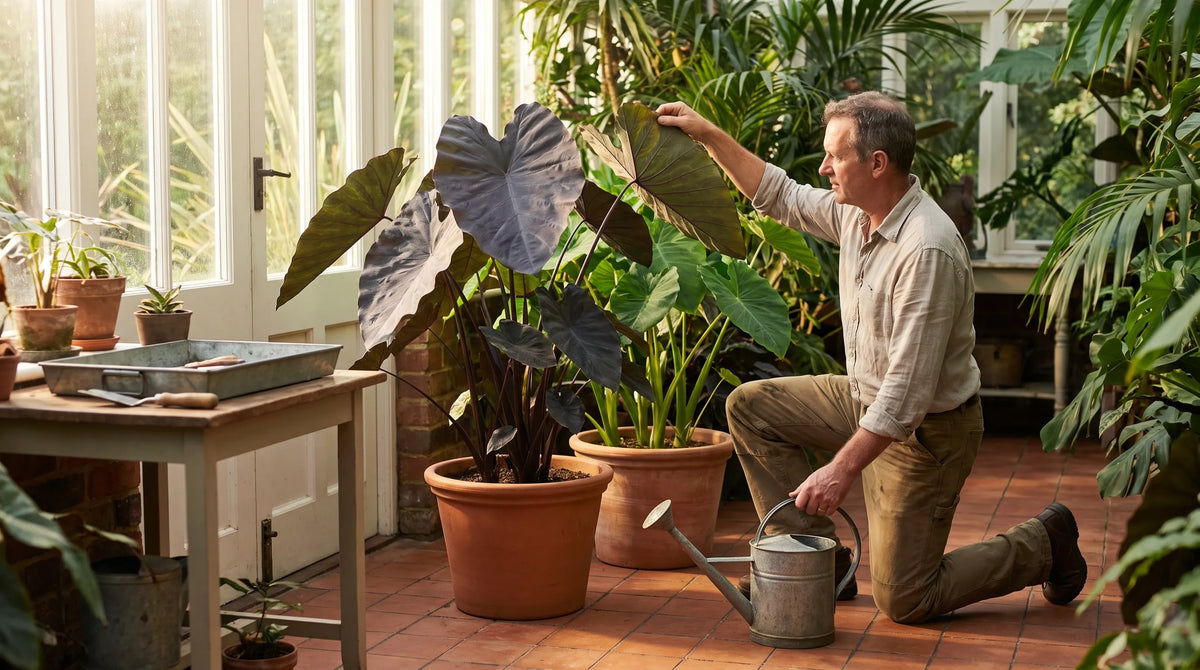
For a compact but bold conservatory plant, Colocasia ‘Aloha’ is particularly compelling. Its dark foliage and contrasting green venation give the eye a strong focal point without the plant feeling coarse. Because it develops with a clumping presence rather than an overly spreading habit, it suits a pot on a low plinth, a tiled corner or a position near pale walls where the leaf markings can be read clearly.
For a more sculptural mood, Colocasia ‘Pharaoh’s Mask’ brings a rarer kind of drama. Its deeply shaped foliage and dark raised veins make it feel almost carved. In a conservatory, that architectural quality is valuable because the plant remains visually interesting at several distances: from the doorway, across a table and close at hand when the evening light runs along the venation.
These are not anonymous “big leaf” plants. They are collector specimens, and they reward a grower who can balance spectacle with patience.
For three very different expressions of the genus, compare ‘Blue Hawaii’, ‘Tiger Cup’ and ‘Black Magic’.
Pairing dark foliage with the room
Dark leaves can disappear in a dim corner, so stage them thoughtfully. Place them against limewashed brick, pale stone, terracotta or a light-painted wall. A dark-leaved conservatory plant also benefits from neighbours with softer green foliage, finer texture or upright growth, so the composition has depth rather than becoming a single shadowy mass.
Containers matter too. Glazed pots can echo leaf sheen, while unglazed terracotta lends a drier, old glasshouse character. If your chosen specimen likes consistent moisture, place terracotta use with care, as it breathes and dries more quickly than plastic or glazed ceramic.
Water, roots and the question of modern growing systems
Watering is where many conservatory ambitions falter. In active growth, tropical foliage can drink with impressive enthusiasm. In winter, the same compost may remain damp for too long. The grower’s art is to change pace with the season.
A dramatic conservatory plant should be watered according to root activity, not the calendar alone. In spring and summer, check frequently, especially during heatwaves. In autumn and winter, let the plant’s growth rate guide you. If new leaves are slower and the room is cooler, reduce watering accordingly while avoiding total desiccation for species that dislike drying out.
For hydroponic and semi-hydroponic growers, conservatories offer both opportunity and caution. LECA, mineral substrates and reservoir systems can help maintain steady moisture around vigorous tropical roots, which is useful during warm months. The risk comes when the glasshouse cools and the reservoir remains cold. Warm roots feed the spectacle; cold, wet roots invite decline.
Good airflow also belongs in this conversation. It reduces stagnant humidity around leaves and helps surfaces dry after misting or cleaning. A conservatory may look serene, but the air should never feel stale.
Styling for drama without overcrowding
Collectors are wonderfully prone to abundance. One rare plant becomes three, three become a bench and the bench becomes a polite jungle by Michaelmas. Yet a specimen plant needs space around it, otherwise its form is lost.
When placing a conservatory plant, give it a visual stage. This could be the end of a long sightline, a broad corner by a chair or the centre of a small group arranged by height. Let one plant command the scene and allow supporting plants to remain supporting plants.
A simple arrangement often works best:
- One principal specimen with bold foliage
- One medium companion with a contrasting leaf shape
- One lower plant or mossed surface to soften the pot line
- Empty space, which is not wasted but deliberately composed
If you own several rare Colocasia cultivars, rotate the most dramatic one into the prime position during its finest season. The others can rest in brighter growing positions until they are ready for their own moment of display.
Seasonal care for lasting theatre
A conservatory collection should change through the year without collapsing into disorder. Spring is for repotting, waking roots and increasing water gradually. Summer is for feeding, shading and watching for pests. Autumn asks you to slow the hand. Winter asks you to observe rather than fuss.
The best conservatory plant for year-round drama is not necessarily one that grows continuously without pause. It is one whose seasonal behaviour you understand. A Colocasia that slows in winter may still earn its place if its growing season is magnificent and if it is stored, positioned or maintained intelligently during the leaner months.
Clean leaves regularly with plain water and a soft cloth, particularly on large-leaved specimens where dust dulls the surface. Inspect the undersides of leaves, the junctions of petioles and the rim of the pot. Spider mites favour dry, warm conditions, and early detection is far easier than a campaign of regret.
Feeding should match growth. A plant pushing large new leaves in warm weather will use nutrients; one resting in cool, dim conditions will not thank you for excess fertiliser. Restraint, in winter especially, is a virtue.
Frequently asked questions
What is the best conservatory plant for dramatic foliage? The best choice depends on your light and temperature, but bold tropical foliage plants such as Colocasia are excellent candidates when warmth, moisture and bright indirect light can be provided. Dark-leaved and sculptural cultivars give especially strong visual impact.
Can Colocasia grow all year in a UK conservatory? Colocasia can perform very well in a warm, bright conservatory, but growth often slows in winter. Keep plants away from cold glass, reduce watering as growth slows and avoid leaving roots cold and wet.
How do I stop conservatory plants scorching in summer? Use blinds, shade cloth or a position set back from the strongest glass. Good ventilation is essential. Leaves that evolved for bright filtered light may still scorch under direct, magnified summer sun.
Do dark-leaved plants need more light? They often need bright conditions to hold their colour well, but that does not mean harsh direct sun. Bright indirect light is usually safer for preserving dark foliage without burning the leaf surface.
Is semi-hydro suitable for a conservatory plant? It can be suitable for experienced growers, especially in warm months, because it offers steady moisture. In winter, monitor reservoir temperature carefully and avoid keeping tender tropical roots cold and wet.
Bring the glasshouse to life
A conservatory should feel collected rather than merely furnished. Choose plants with form, learn the climate of your glass room and give your finest specimens the dignity of space. For rare tropical foliage, particularly distinctive Colocasia, that combination of old glasshouse patience and modern growing knowledge is where the real splendour begins.
If you are building a collection with character, explore the rare tropical specimens at Fullness of Time, where unusual Colocasia and collector plants are cultivated in the UK with the serious enthusiast in mind.


Leave a comment
This site is protected by hCaptcha and the hCaptcha Privacy Policy and Terms of Service apply.