
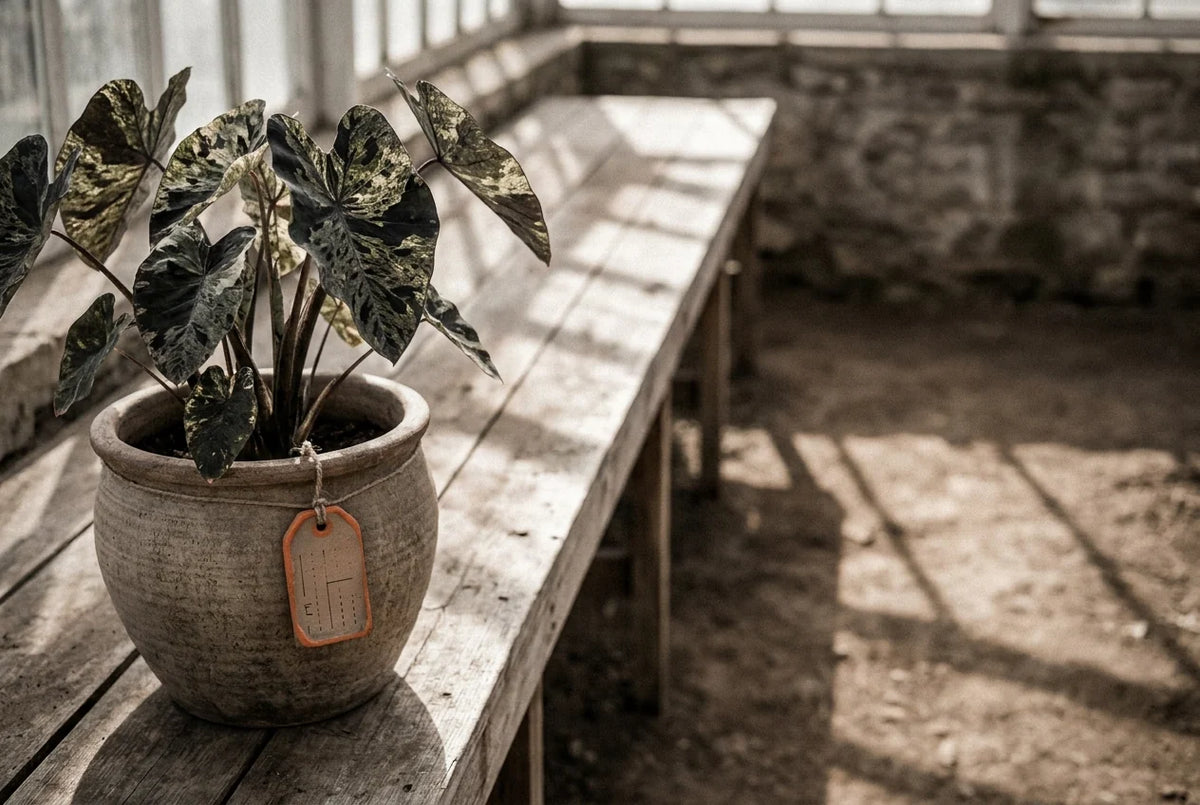
Variegated and Unusual Colocasia Cultivars: What Collectors Are Actually Looking For
Most collectors reach a point where 'Black Magic' no longer satisfies. The cultivar is fine, widely available, and does what it promises, but it represents an entry point rather than a destination. For those who have moved past it, the world of rare tropical plants opens into something considerably more nuanced: variegated Colocasia with unpredictable patterning, violet-stemmed selections commanding twice the price of mainstream stock, and giant-leaved species that redefine scale in a temperate garden.
This piece maps that space with precision. Drawing on current UK pricing data and supply chain realities, it examines the cultivars serious collectors are actually pursuing, what they cost, why they are genuinely scarce rather than artificially restricted, and what distinguishes their care requirements from standard selections. You will find analysis of variegated and colour-variant forms, a detailed look at the premium tier anchored by cultivars such as 'Coffee Cups', 'Fontanesii' and 'Mojito', coverage of giant-leaved species, and a practical framework for prioritising acquisitions when budget and availability both impose constraints. If you already know the basics, this is where the more interesting decisions begin.
Beyond Black Magic: How the Collector Market Has Matured
The tropical foliage boom of the early 2020s brought a great many people to Colocasia who had never previously looked twice at an elephant ear. Most arrived through 'Black Magic', that dependable near-black standard of garden centres and online sellers, and a portion of them stayed. Those who stayed are now a different kind of buyer altogether.
By 2026, the UK collector market for unusual Colocasia forms has consolidated into something recognisably mature. The novelty impulse has largely spent itself. What remains is a smaller, more deliberate community with specific cultivar knowledge, patience for sourcing and a clear sense of what they are actually after.
One distinction worth establishing early is that ornamental Colocasia cultivars, bred and selected for foliage colour, stem character or leaf architecture, are a separate category from the food-crop taro of the same genus. The two share a species name but not a purpose, and their provenance, propagation history and care requirements diverge accordingly. Ornamental selections have typically been stabilised through nursery propagation over generations, and the coloration that makes them desirable can behave differently under cultivation than a standard corm grown for its edible qualities. Knowing which lineage your plant comes from matters when you are trying to maintain it.
Pricing in the UK has settled into a clear hierarchy. Entry-level forms, including the most widely sold black-leaved selections, sit at roughly £11 for a small plant. The premium tier, occupied by variegated forms, unusual colour variants and architecturally distinctive selections such as 'Coffee Cups', 'Fontanesii' and 'Pink China', has consolidated at approximately £22 for a comparable 7cm plant. That is a consistent 2x premium, and it reflects genuine propagation constraints rather than speculative inflation.
Aroid Atlas, which tracks prices across hundreds of aroid species, gives buyers a basis for assessing whether a listing is reasonable before committing.
The three categories that matter most to this collector tier are variegated forms, unusual colour and stem variants, and giant-leaved selections. Each carries distinct supply constraints, care demands and acquisition logic, all of which this piece examines in turn.
What 'Uncommon' Actually Means in the UK Supply Chain
Every premium Colocasia cultivar currently tracked in the UK market carries an 'Uncommon' availability classification, and that label is doing real work. It does not describe a marketing posture or a deliberate restriction of supply. It reflects the straightforward biological fact that these plants are slow to multiply, slow to size up, and slower still to reach a condition where selling them serves any honest purpose.
Colocasia propagates primarily through offsets and corm divisions rather than seed, and the premium cultivars produce these at a modest rate. A well-grown 'Mojito' or 'Fontanesii' might yield two or three usable offsets in a season. Each then requires several months of growing-on before it reaches a size worth offering to a collector. The cumulative time from division to saleable plant is typically the better part of a year, often longer for smaller-starting material. Variegated forms add a further complication: reduced chlorophyll means reduced vigour, so the already unhurried process slows further. There is no shortcut to this.
The origin of stock matters considerably. Plants propagated and grown on in the UK have already adapted to British light levels, water quality and ambient humidity. They arrive already acclimatised. Imported material, typically rooted in Dutch or Central European nurseries and shipped through the Netherlands, arrives in a different physiological state. It is not inferior by nature, but it needs time. A plant pushed straight from transit into a warm sitting room without a proper settling period is under stress it may not show immediately. Yellowing, limp petioles and sudden root failure weeks after purchase are often the delayed consequence of inadequate acclimatisation rather than any fault in ongoing care.
UK import regulations require imported ornamental plants to meet phytosanitary standards, but compliance with those checks does not guarantee the plant has been given time to stabilise after transit. That step is down to the seller.
Seasonal patterns follow the genus's natural rhythm. Spring and early summer, from April through June, is when most UK growers divide and repot, and when propagated stock tends to appear. The window closes quickly. Certain cultivars, particularly the more vigorous coloured-stem forms, occasionally appear through autumn in very small numbers, but a collector waiting for a specific premium cultivar outside the spring window may be waiting until the following year.
When sourcing, roots are the first thing to assess. Healthy, well-rooted stock holds its compost firmly when tapped from the pot; pushed-early material does not. Leaves should be upright and turgid, not papery at the margins. Any sign of softness at the petiole base warrants caution.
Variegated Forms: Tropical Variegated Foliage at Its Most Unpredictable
Variegation in Colocasia is looser and more atmospheric than the architectural patterning of Alocasia or the crisp white sectoring of variegated Philodendron, and in the best forms genuinely surprising from leaf to leaf.
The distinction that matters most practically is between relatively stable patterning, where the same general colour distribution repeats with each new leaf, and the erratic splashing seen in cultivars like 'Mojito'. That splashing is caused by unstable chlorophyll distribution rather than clean chimeric tissue separation, meaning no two leaves are identical and no grower can fully predict the next unfurling. For some collectors this unpredictability is the appeal; for others, accustomed to aroids bred for consistency, it takes adjustment.
Colocasia esculenta 'Mojito'
'Mojito' produces broad, arrow-shaped leaves in dark saturated green overlaid with irregular blotches ranging from lime-green to near-black. The effect when the plant is growing well is almost painterly. At £17 per 7cm plant as of September 2026, the price reflects both propagation difficulty and consistent demand.
'Mojito' needs bright, indirect light to maintain its patterning. North-facing rooms or deep interiors will gradually produce leaves trending toward plain green as the plant defaults to maximising photosynthesis. Bright, indirect light -- realistically a south- or east-facing windowsill -- is the practical minimum indoors, supplemented by a grow light through the British winter if the plant is to remain active.
Colocasia esculenta 'Illustris'
'Illustris', known as Imperial Taro, operates differently. The variegation is more structural: very dark, near-purple leaves with contrasting lighter zones along the midrib and primary veins, creating a pattern readable from across a room. Collectors generally find 'Illustris' more forgiving of the lower light levels common in British interiors than 'Mojito', though both benefit from the brightest available indirect position, making it one of the more forgiving premium cultivars through a grey winter.
'Illustris' at £18 sits just above 'Mojito' in the current UK price hierarchy.
Reversion and Light
Both forms will revert toward plainer colouration under sustained low light. This is adaptation, not damage; the genetics are unchanged. Returning the plant to brighter conditions typically restores patterning within a few leaf cycles. Reversion that persists despite adequate light is more likely a root or nutrient issue.
Colocasia Variegation in a Mixed Collection
Collectors growing both Colocasia and aroids like Alocasia or Philodendron will notice Colocasia variegation reads differently in a display. The leaves are larger, softer in texture and more horizontal, so patterning catches light differently and sits lower in an arrangement. Where a variegated Alocasia draws the eye upward through architectural structure, a 'Mojito' spreads its markings across the table. Both have their place, and collectors building a mixed foliage display tend to find they complement rather than compete with each other.
Pink Stems, Violet Stalks and Unusual Colour: A Closer Look at the Premium Tier
Stem and petiole colour represent a different kind of collector proposition to variegation. Where 'Mojito' and 'Illustris' offer patterned leaf surfaces, this trio works through structure and saturation, and the effect in a considered collection is altogether more architectural.
'Pink China' is genuinely unusual, not simply in name. The pink colouration runs through the petiole with a consistency that most pink-stemmed tropical foliage plants fail to maintain past the juvenile stage. The plant grows with reasonable vigour, producing upright, broadly arrow-shaped leaves on those distinctive blush stems, and it holds its character without the cultural coddling that true variegates demand. At £22 per 7cm plant it sits at the ceiling of the UK premium tier, a price that reflects both collector demand and the slow rate at which clean, well-coloured stock reaches the market.
'Fontanesii' offers something different in character, though it shares that £22 price point. The stems move from deep violet at the base into near-black territory, and the overall plant has a vigour that most delicate variegated forms simply cannot match. For collectors who find themselves repeatedly losing premium plants to the combination of low British winter light and inconsistent watering, 'Fontanesii' makes a compelling argument: strong pigmentation, strong constitution, strong presence. The drama is real without the fragility.
'Coffee Cups' earns its place in this section through structural rather than chromatic interest. The leaves cup distinctly upward along their margins, pooling water at the centre in a way that reads almost theatrical in a glasshouse setting. It is the form that stops visitors mid-step. Collectors drawn to architectural foliage, the kind who might also keep large Alocasia or sculptural Philodendron, consistently cite this as one of the more distinctive things Colocasia does. It also sits at £22, a price anchored by that structural distinctiveness rather than rarity alone.
All three are sensitive to light in the same direction. Move any of them into genuinely inadequate brightness and the violet and pink tones begin to dull; the colour is not lost immediately, but it softens into something greener and less considered, which rather defeats the purpose. A bright, indirect position is the minimum, and in a British interior from October through February that frequently means supplementary light.
Together these cultivars bring a quality to a tropical foliage display that no amount of dark-leaved planting quite replicates: warmth, depth and the sense that the collection has been assembled with genuine discrimination.
Giant-Leaved Selections: Growing Colocasia gigantea in the UK

Stem colour and structural drama occupy one end of the premium spectrum; sheer scale occupies the other. Colocasia gigantea, the Thailand Giant Elephant Ear, is a different species from the esculenta cultivars described above, and the distinction is not merely taxonomic. The leaves are a distinctive powdery grey rather than the deep greens and near-blacks of esculenta, and in genuinely warm conditions the plant produces white, calla-lily-like flowers on six-inch clusters. It is grown for volume, presence and a certain prehistoric theatricality.
Under optimal tropical conditions, gigantea is capable of reaching nine feet in a single season, with mature leaves measuring five feet long and four feet wide. In a British growing season, those figures are not realistic. UK summers lack the sustained heat and humidity the species genuinely demands, and plants grown indoors or in conservatories will reach impressive but considerably more modest dimensions. Expect broad, well-formed leaves and strong petioles rather than the near-architectural scale documented in warm-climate trials. A conservatory with good light and reliable warmth will produce more satisfying results than a north-facing living room.
That measured expectation is worth holding alongside the price point. At £13 for a 7cm plant as of September 2026, gigantea sits at the lower end of the premium tier, level with 'Black Coral' and significantly below the £22 commanded by 'Coffee Cups' or 'Pink China'. For collectors curious about the species, the entry cost is relatively accessible; the investment is in the space and conditions needed to grow it well over time.
On the question of variegated gigantea: searches for Colocasia gigantea variegated reflect collector aspiration more than current market reality. Variegated forms have been documented, but reliably available, well-established UK stock is scarce to the point of being effectively absent from the mainstream specialist market at present. The search query tends to surface esculenta variegates or unverified listings rather than genuine gigantea variegation. Collectors chasing this form should treat any offering with caution and ask for propagation provenance before committing.
Overwintering is the most practical question for UK growers. Colocasia gigantea is not frost hardy. For established plants, lifting the corm in autumn, cutting back the foliage, and storing it dry in a frost-free location, a cool garage or shed that stays above freezing, is the most reliable approach. Smaller plants may overwinter more successfully as container specimens kept barely moist in a warm indoor space. Attempting outdoor storage without frost protection is not advisable in most of Britain, including milder western counties.
Care Differences That Actually Matter at This Level
Growing any Colocasia well is not complicated. Growing a £22 specimen of 'Pink China' or 'Coffee Cups' well, through a British winter, is a different proposition.
Light is the first thing to resolve, and most UK interiors fail it. Variegated and coloured-stem forms need a bright, indirect position -- realistically a south- or east-facing windowsill -- to maintain their patterning and petiole colour through the growing season. Supplementary LED lighting is not optional for these cultivars indoors from October to March; it is the difference between a plant that holds its character and one that produces washed-out, progressively greener leaves. A full-spectrum grow light positioned close to the canopy and run for an extended daily period is a practical solution for most collectors. Colocasia gigantea, being less dependent on light-driven pigmentation, is more forgiving, but variegated and violet-stemmed forms are not.
Root stress is the hidden cause of most premium cultivar failures -- 'Mojito' and 'Illustris' in particular revert toward plain green and show stunted growth when moisture is inconsistent, making substrate choice critical. The substrate must drain freely while retaining consistent moisture at root level. A mix of perlite, coir and a small proportion of bark achieves this; standard multipurpose compost compacted into a pot does not.
During the growing season, feed generously with a balanced liquid fertiliser; large-leaved selections including Colocasia gigantea have considerable nitrogen demand to support their growth rate. From October, reduce feeding to monthly at most; from November to February, stop entirely unless the plant is under supplementary light and actively growing.
Spider mite is the pest most likely to damage premium cultivars indoors. Warm, centrally heated rooms with low humidity are precisely the conditions mites prefer, and thinner-leaved variegated forms appear more susceptible than the thicker-textured near-black selections. Check the undersides of leaves weekly and treat at the first sign with a suitable miticide or neem-based spray. Waiting for visible webbing means the infestation is already advanced.
Semi-hydroponic growing addresses several of these pressures simultaneously. By maintaining a consistent reservoir level below the root zone, the risk of both waterlogging and drought stress is effectively eliminated. Fullness of Time's decorative semi-hydroponic planters are designed with exactly this in mind: stable moisture, improved aeration and a finish that suits a considered interior rather than a production nursery shelf. For premium cultivars where root health directly determines leaf quality, that consistency is worth more than any feeding regime.
Prioritising Acquisitions: A Framework for Collectors
Knowing how to grow these plants is only half the task. Knowing which ones to acquire, and in what order, is what separates a coherent collection from an expensive lesson in attrition.
The sensible sequence runs from resilience outward. 'Fontanesii' and 'Coffee Cups' tolerate reasonable indoor conditions without the fragility of true variegates; establishing one of these successfully gives you a calibrated sense of what your space actually offers before you commit to a 'Mojito' or a difficult chimeric form. The variegated cultivars covered in earlier sections are more sensitive to inconsistent moisture, low light and root disturbance. Earning that knowledge cheaply, on a £22 plant rather than discovering it later, is prudent collecting.
Price warrants scrutiny before purchase. Within the £11--£22 premium tier, it is worth distinguishing whether a high price reflects genuine rarity, propagation cost, sustained demand or a temporary supply gap. 'Illustris' at £18 sits just above 'Mojito' in the current UK price hierarchy. 'Coffee Cups' at £22 is priced at the ceiling of the current tier; collectors who value structural foliage over colour tend to cite it consistently. A cultivar priced high because supply is temporarily thin may not hold that value once restocking normalises.
The choice between 'Coffee Cups' and 'Fontanesii', both at £22, is not a price question at all. One offers architectural geometry: those distinctive upward-cupping leaves that read as a sculptural object in a considered interior. The other offers theatre through colour, the deep violet petioles that intensify with good light and carry a sense of scale even in a modest pot. They are not interchangeable. Collectors who have a particular display intention should acquire for it rather than acquiring on availability alone.
Sold-price data from tracking platforms shows when demand for specific cultivars is active and how quickly stock moves -- useful context for 'Uncommon' forms where windows are short.
Fullness of Time releases premium and unusual Colocasia cultivars in small batches as properly rooted, acclimatised plants become available. Current stock listings are maintained on the site and updated as releases occur, making it worth checking regularly rather than waiting for a specific season.

Black Coral and the Near-Black Forms Worth Knowing
Once you have worked through the acquisition logic, black-leaved forms deserve a separate reckoning. They occupy a curious position in the collector hierarchy: familiar enough that newcomers reach for them first, yet refined enough at the premium end that experienced growers continue to value them.
'Black Coral' sits at £13 per 7cm plant, the same entry point as Colocasia gigantea in the current UK market. That price is not arbitrary. What separates it from 'Black Magic', the cultivar most collectors will have encountered at the garden centre stage, is less about base colour than about everything surrounding it. Collectors who have grown both note that 'Black Coral' carries a noticeably glossier leaf surface in good light, a faint midrib contrast against the near-black lamina, and a somewhat more compact, upright growth habit -- though these distinctions are subtle and individual plants vary.
The broader appeal of black foliage plants has proved more durable than trend cycles might suggest. Against pale walls, light stone floors and the considered interiors that many collectors now curate, a genuinely near-black leaf provides contrast that variegated forms cannot replicate. Variegation draws the eye into complexity; near-black simplifies and anchors. Many serious collections benefit from both, and the near-black tier earns its place as a structural element rather than a novelty.
In terms of UK availability, 'Black Coral' is the most consistently encountered of the premium near-black forms, appearing across specialist online stock with reasonable regularity. 'Illustris' overlaps this category to some extent, with its dark lamina and contrasting midrib zones, though it commands a higher price point and is covered separately. Fully black-stemmed selections occasionally appear in UK listings, but stock tends to be sporadic and quickly absorbed when it surfaces. Patience rather than urgency applies.
Under UK light conditions, near-black forms are meaningfully more forgiving than variegated or pink-stemmed cultivars, but they are not unconditional. Inadequate brightness does not bleach them in the way it strips a variegated form, but it does dilute depth, shifting the leaf toward a dull dark green rather than a true near-black. A bright indirect position, equivalent to a well-lit room a metre or two from a south or west-facing window, is the realistic minimum for maintaining the quality that makes these plants worth growing.
What the Serious Collector Should Take Away
The distinctions between cultivar categories matter more than collectors sometimes acknowledge until something expensive goes wrong. Variegated forms, unusual colour and stem selections, and giant-leaved species are not interchangeable tiers of difficulty; they are genuinely different acquisition decisions, with different care demands, different availability windows and price rationales that reflect real propagation constraints rather than market positioning. Understanding which category you are buying into, before the plant arrives, makes the difference between a successful addition and an expensive lesson.
Supply at the premium tier is genuinely constrained, and restocking windows are short -- patience and a reliable specialist source matter more than monitoring generalist platforms.
The most consistent cause of loss is applying entry-level care habits to premium cultivars -- the colouration itself signals the sensitivity adjustments required.
Fullness of Time stocks a carefully selected range of unusual and premium Colocasia cultivars, released in small batches as well-rooted, acclimatised plants rather than pushed to market before they are ready. Current availability can be found in the shop, where stock listings reflect what is genuinely on hand. Alongside the plants, the site's growing documentation covers propagation methods, substrate choices, seasonal care adjustments and semi-hydroponic trials conducted under real Worcestershire conditions. For collectors maintaining expensive plants through a British winter, that record of firsthand experience is at least as useful as the plants themselves.
Conclusion

Collecting at this level rewards those who approach it deliberately. The cultivars worth pursuing are genuinely scarce, not artificially so; understanding that distinction saves both money and frustration. Variegated and premium-coloured forms demand care protocols tailored to their specific sensitivities, and applying standard Colocasia habits to unusual cultivars is the most common and costly mistake collectors make. Building a relationship with a specialist grower who propagates transparently and releases stock only when plants are ready is a more reliable strategy than chasing availability across generalist platforms.
If you are ready to develop your collection with cultivars that are worth the investment, browse current availability in the Fullness of Time shop and explore the growing documentation alongside it. The right plant, properly sourced and correctly grown, is where serious collecting actually begins.


Leave a comment
This site is protected by hCaptcha and the hCaptcha Privacy Policy and Terms of Service apply.