Modular Plant Supports for Large-Leaved Tropicals: Why Standard Stakes Fail at Scale
There is a moment familiar to anyone who has tried to support a mature Colocasia through a British summer: you press a bamboo cane into the compost, loop a soft tie around a stalk the width of a drainpipe, and understand immediately that the proportions are wrong. The cane is doing almost nothing. The plant has its own structural logic, and you have not engaged with it.
Large-leaved tropical plants exert forces that conventional staking systems were never designed to handle. Stalks six inches wide at the base, carrying leaves two to four feet long, generate leverage that bends canes, misaligns ties and concentrates damaging stress precisely at the petiole-lamina junction where the leaf is most vulnerable. The result is bent petioles, collapsed leaves and plants that look worse for being supported than they would have looked unsupported.
This piece examines why standard bamboo canes and wire hoops fail at scale, what the structural biology of peltate leaves actually demands from a support system, and how modular, adjustable frameworks produce better outcomes for the plant and the display alike.
A Stalk Six Inches Wide and a Cane That Was Never Equal to It
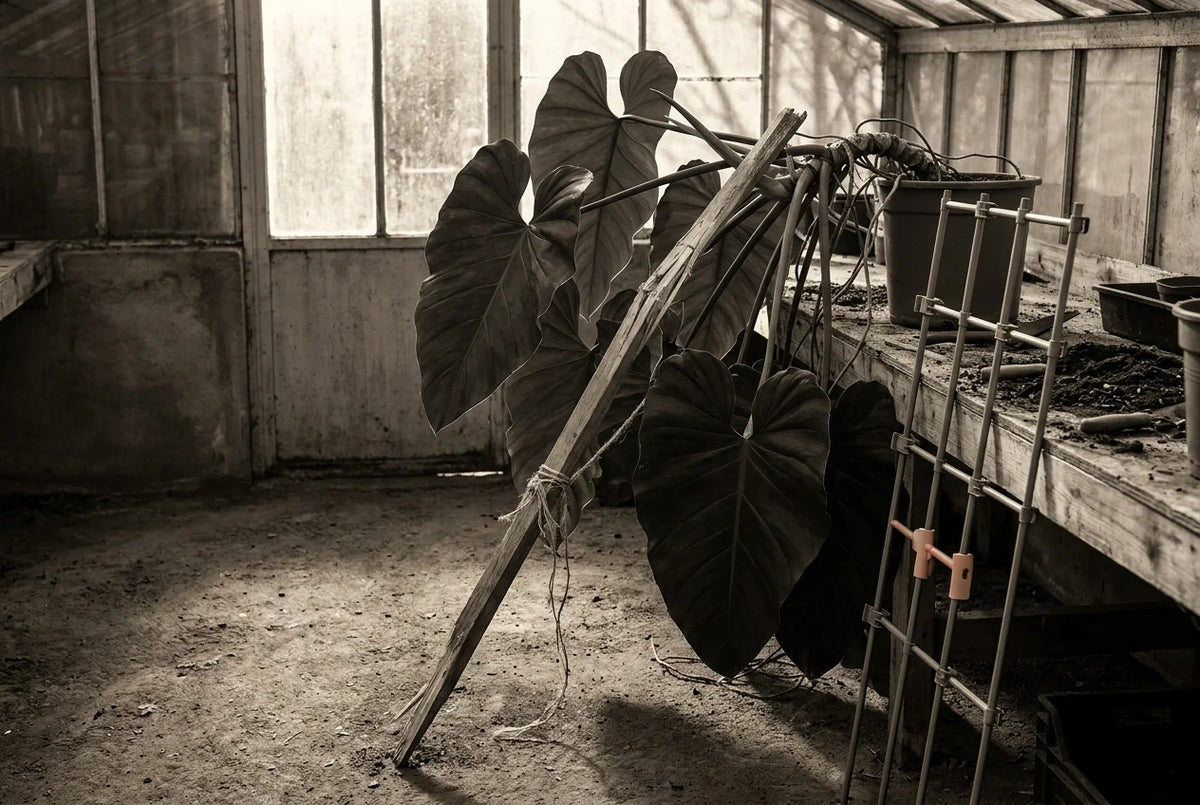
There is a particular kind of disappointment that comes quietly. You notice it from across the room: a leaf that was reaching outward this morning is now tilted at an angle it was never meant to hold, the petiole creased where it meets the blade, the whole magnificent thing diminished. You look for the cane. It is still there, perfectly upright, doing precisely nothing useful.
A mature Colocasia gigantea 'Thailand Giant' develops a stalk base approaching six inches across. The leaves run two to four feet in length. That is not a houseplant in any conventional sense; it is a structural event, and the force concentrated at the point where the petiole meets the lamina is correspondingly serious. Under the weight of a leaf this size, held at the end of a long stem that rarely grows perfectly vertical, the junction between stalk and blade becomes the most mechanically stressed point in the entire plant.
Bamboo canes are not designed for this. A single stake inserted at a fixed point can only support what happens to align with it, and a large tropical plant growing toward variable light in a British interior will not oblige. The cane slips under lateral load, or holds just long enough for the petiole to bend against it at the wrong angle. Once that junction has been stressed, the leaf rarely recovers its original position.
The fault is not with the grower. It is a straightforward mismatch between the geometry of conventional staking and the structural demands of large-leaved tropical plants. Understanding that mismatch, and what a properly considered support design would address instead, is what the rest of this piece examines.
What Elephant Ear Stalks Are Actually Doing Structurally
Understanding why begins with the geometry of the leaf itself. Colocasia belongs to a group of plants described as peltate: the petiole does not attach at the edge of the leaf but at a point on the underside of the lamina, somewhere near its centre. This arrangement creates what researchers have characterised as a significant and abrupt geometrical change from a beam to a plate within a very compact zone. All the mechanical transition between a long, flexible stalk and a broad, relatively flat leaf surface happens across a short distance at that junction, and stress concentrates there accordingly.
This is not a quirk peculiar to Colocasia. A peer-reviewed study published in Biomimetics and indexed through PMC/NIH documented peltate leaf morphology across 357 species representing 25 orders, 40 families and 99 genera, the majority being herbaceous perennials from subtropical and tropical zones. The structural vulnerability at the petiole-lamina junction is a recurring characteristic of this entire category of tropical foliage, not an anomaly in one genus.
At the scale of 'Thailand Giant', a six-inch stalk base carrying leaves up to four feet long, those forces become genuinely consequential. A leaf of that dimension, attached off-centre on a long petiole, behaves as a lever. Its weight generates rotational force at the junction, and any displacement from the vertical, whether from the plant leaning, a stem growing at an angle, or an external load, amplifies that force considerably.
Colocasia leaves have comparatively low lamina stiffness, parenchymatous tissue that deforms or tears under misdirected load rather than resisting it. The larger the cultivar, the greater the leverage, and the more clearly a single fixed stake becomes structurally unequal to what is being asked of it.
The Specific Failure Modes of Bamboo Canes and Wire Hoops
Knowing where the force concentrates is one thing. Understanding why a bamboo cane makes it worse is another.
The fundamental problem with a single vertical stake is geometric. It assumes the plant will grow straight up and position its stems conveniently close to where the cane was inserted in spring. Large tropical plants rarely oblige. Colocasia produces stems at irregular angles, reaching toward light, responding to rotation, expressing the natural asymmetry of vigorous growth. When the stem diverges from the cane's fixed vertical, the tie that was meant to help becomes a lever, directing lateral force onto the petiole-lamina junction. Rather than distributing load, a single restraint point concentrates it.
Wire hoops introduce a different but related failure. They encircle the stem rather than supporting it, applying inward pressure from multiple sides without addressing the downward and rotational load that a large peltate leaf actually generates. A hoop sized for a plant in May is simply too small for the same plant in August, and there is no means of adjustment. The plant grows through or around it, and the hoop either deforms the stem or becomes irrelevant.
The seasonal progression compounds everything. A cane and tie system calibrated for a young plant does not become adequate for a mature one; as growth continues through the season, the support becomes progressively mismatched to the load it is asked to carry.
Cumulative micro-stress is the subtler risk. Repeated minor misalignment at the petiole junction need not produce immediate visible damage to cause harm. The effects accumulate across a full growing season, weakening tissue that looks intact until it does not.
For a small container plant, these limitations are manageable. At scale, they are predictable failures waiting for a warm August afternoon.

Design Principles for Supports That Work With the Plant
The inversion at the heart of good support design is straightforward: the support should conform to the plant, not the other way around. Every failure mode described above traces back to the opposite assumption, that the plant will eventually settle into the shape the support provides. With large-leaved tropical plants, it rarely does.
Force distribution is the primary engineering objective. A single restraint point concentrates lateral load precisely where the structure is most vulnerable; multiple adjustable contact points spread that load across the length of the stem and petiole, reducing stress at the petiole-lamina junction rather than directing it there. A support that adds to that burden by pulling the stem toward a fixed position is doing the opposite of what is needed.
Adjustability to irregular stem angles matters equally. Tropical plants grown in variable light conditions rarely present a perfectly vertical stem; they lean, reach and settle at angles that reflect their environment and their cultivar's natural habit. A support that accommodates this is structurally sound. One that insists on correcting it introduces a sustained sideways force at exactly the point where sustained sideways force causes damage.
Seasonal development compounds all of this. A structure adequate for a plant in April may be genuinely inadequate for the same plant by August. Modular components that can be repositioned, extended or reconfigured as the plant develops remove this mismatch without requiring the grower to start again.
The Fullness of Time modular support range has been designed from these principles outward, drawing on the Victorian glasshouse and botanical collection tradition of hardware that is both engineered and considered, built from substantial materials with replaceable components rather than disposable plastic fittings. A system designed to work with the plant's own development should, in practice, require noticeably fewer adjustments across the growing season, because it is not in constant contest with the plant it is meant to hold.
When the Support Is Part of the Composition
There is, of course, a second dimension to all of this. Structural adequacy matters enormously, but so does what the support looks like standing in the corner of a well-considered room.
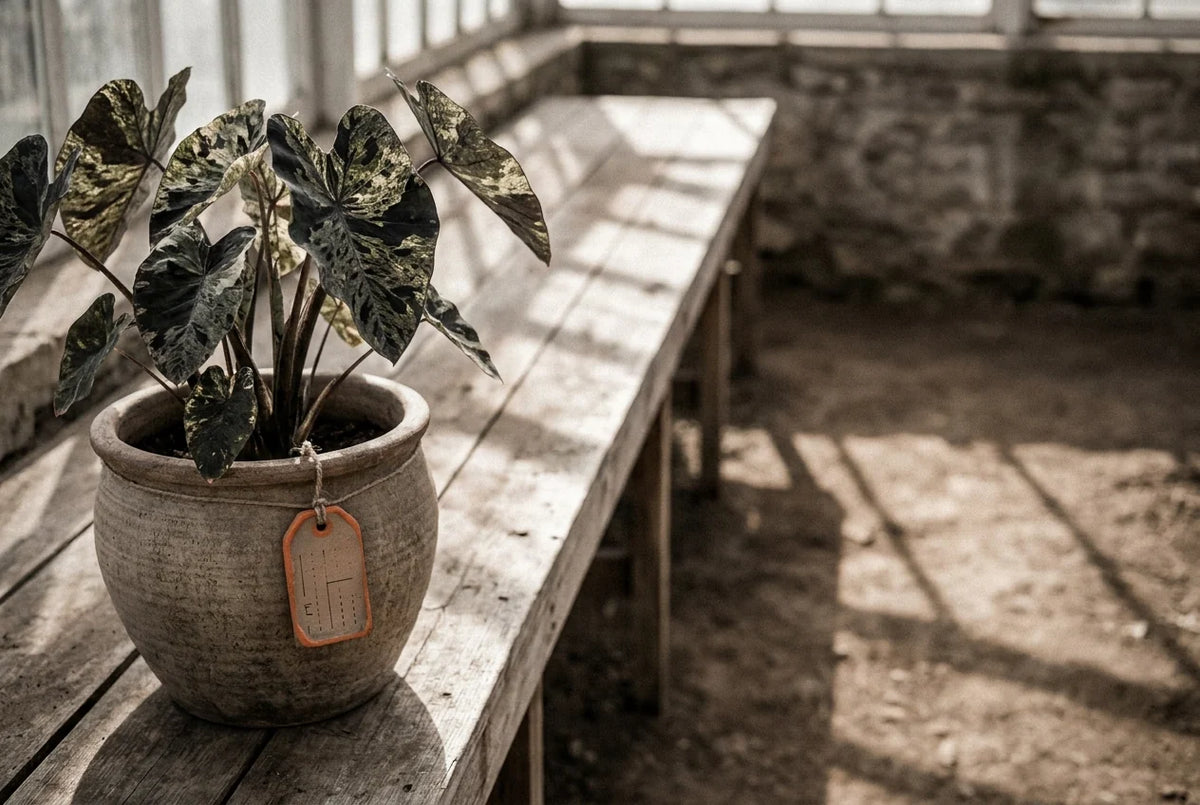
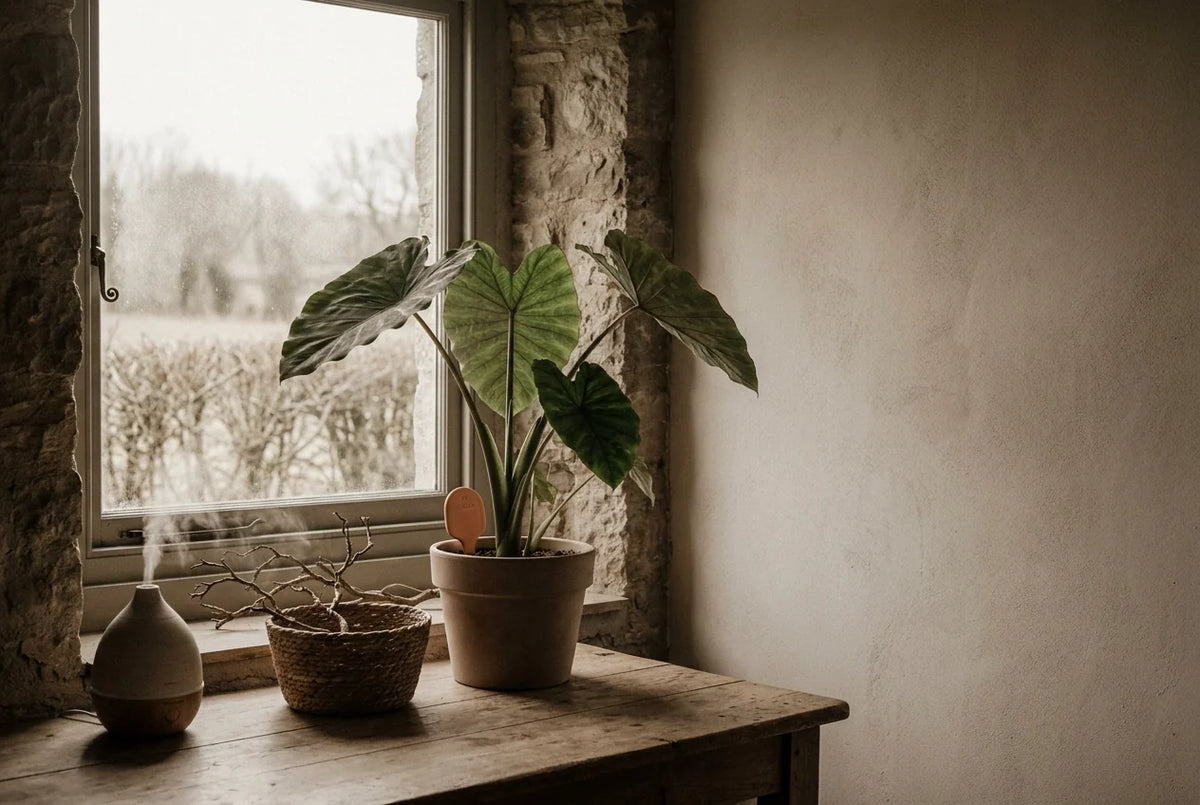
Large-leaved tropical plants are no longer grown solely as garden fillers or summer bedding. Collectors growing named Colocasia cultivars treat them as specimens: positioned deliberately, potted with care, displayed where the full architecture of the leaf can be appreciated. In these contexts, the support is not a temporary measure to be tucked out of sight and removed at season's end. It is present in the composition at all times, as visible as the pot or the plant itself.
A bamboo cane bound with garden twine communicates something specific, and it is not confidence. Even when it functions adequately, a support that reads as provisional or improvisatory undermines the display it is meant to serve. The visual language of the hardware should be consistent with the considered aesthetic of what it holds.
The Victorians understood this intuitively. In the great glasshouses and conservatories of the nineteenth century, structural elements were not concealed behind the planting; they were designed to be seen. Cast-iron staging, ornamental ties, engineered supports: these were part of the spectacle. The architecture and the horticulture were understood as a single composition, and the hardware was made accordingly.
That precedent is worth recovering. A support that is correctly proportioned for the plant's actual scale will tend to look deliberate precisely because it is. Conversely, a cane visibly bowing under the weight of a three-foot peltate leaf carries its own argument for replacement.
For collectors growing cultivars selected for the particular drama of their leaf form, the stakes are higher still. A petiole held at the wrong angle, or allowed to droop under its own load, diminishes the very characteristic that made the cultivar worth growing.
Scale, Season and the British Growing Context
All of this matters rather more in Britain than it might elsewhere. Colocasia sits at USDA hardiness zones 7b to 10 and above for reliable outdoor growing, which means that in most of England and Wales it is a container plant, overwintered under cover and moved back out once late frosts have passed. The growing season here is compressed, the light variable, and the plant spends a good portion of its year inside.
That indoor period introduces a problem that growers in warmer climates rarely face. A large Colocasia placed near a window or in a conservatory will lean toward the light, producing the kind of irregular stem angles that no fixed bamboo cane can sensibly follow. The plant is not misbehaving; it is doing exactly what it should. The support system is simply not designed for it.
Then there is the question of moving the thing at all. A mature plant requiring six feet of growing space, set in the substantial container its root system demands, is not easily shifted. A fixed support structure makes that harder still, catching on doorframes, resisting any attempt to lay the plant on its side for transit. A modular system that can be partially dismantled before the October move indoors is not a refinement; for most UK growers, it is a practical necessity.
The range of elephant ear sizes in British collections adds another layer. Compact cultivars present a manageable challenge. Colocasia gigantea at its largest is a different proposition entirely, with the structural demands described earlier scaling in direct proportion to the leaf area. Support requirements that are adequate for a smaller form will not transfer upward.
The Satisfaction of a System That Respects the Plant
There is a particular satisfaction in getting this right. A three-foot leaf held at its natural angle, the petiole carrying its load without visible strain, the whole plant reading as it was always meant to: composed, unhurried, exactly itself. That moment does not happen by accident. It is the result of a support doing its job at the right points, in the right directions, without fighting the plant's own geometry.

The failure modes of standard staking have been described; what matters here is the outcome. The plant is not difficult; the tool is wrong.
When assessing any support for large tropical foliage, three questions are worth asking. Does it distribute force across more than one contact point? Does it accommodate the actual stem angle, rather than assuming an ideal vertical the plant may never achieve? And can it be adjusted as the plant grows through a season? If the answer to any of those is no, the support will eventually prove inadequate, and the consequences will show in the leaf.
Modular systems answer all three. They work with the plant's structure rather than against it, and they tend to look better doing so, precisely because a support proportioned to the load it carries reads as deliberate rather than provisional.
Fullness of Time is developing a modular support range built around these principles. Further details, alongside practical growing resources for Colocasia and other large-leaved tropicals, are available in our growing guides collection.
Conclusion

If you are growing Colocasia, Alocasia, or any large-leaved tropical at serious scale, the support system deserves the same attention as the soil and the watering regime. The principles are straightforward: distribute force, accommodate the plant's real geometry, and build in the capacity to adjust as the season progresses. Explore the Fullness of Time growing guides to find practical resources built around these principles, and discover our modular support range designed specifically for plants that have outgrown conventional solutions.

Leave a comment
This site is protected by hCaptcha and the hCaptcha Privacy Policy and Terms of Service apply.